Showing posts with label Teaching and Learning. Show all posts

Thursday, June 20, 2024

Micro Learning: An Introduction

Micro Learning: An Introduction

Every time we come across some information, our brain retains some parts of it in the form of memory. Both the short and long-term memories have an important role to play in the learning process. Also, a huge fraction of information storage takes place in the subconscious mind. It registers information in pieces and fosters the learning process. This implies, bite-sized information can be easier to store for a longer time. This concept sets the foundation for Micro-Learning.

Micro-Learning is gradually becoming an essential component of educational and corporate training. This is so because the technology-driven learning process, which often involves Gamification, makes extensive use of this component. But what is micro-learning? How does it work? What are its advantages and disadvantages? These queries are answered through this blog.

What is Micro-Learning?

It is a skill-based approach that aims to deliver information by breaking it into bite-sized chunks. This information mainly contains highly focused points which give a complete idea of the concept. Additionally, instead of using long statements, it employs text as well as multimedia to deliver information in the form of texts (phrases), images, short video/audio, games, etc.

Furthermore, this approach works well to quickly train employees in the in corporate sector. Certain key features that contribute to make it an effective choice for designing training modules include the following:  

a) It is a quick form of learning as the modules are short.

b) Only relevant points are emphasized.

c) Also, content is produced in a variety of forms such as images, videos, podcasts, games, etc.

d) The content is accessible through any device, irrespective of place and time.

Key Benefits of Micro-Learning

Micro-learning, as skill-based learning, is the go-to method for designing content to cater to the needs and objectives of training with less time consumption. Therefore, more educational institutions are turning towards this strategy of producing and delivering information quickly. The key benefits that contribute to its growth are mentioned here.

I. Quick Lessons

Micro-learning involves delivering crisp information on a topic. Thus, a micro-training lesson can be built in a very short duration of time, eventually reducing lesson delivery time as well. 

II. Affordability

Micro-training courses are inexpensive to produce. Due to its crisp form, it does not require any specific tools, rather, a regular LMS works well to fulfill the purpose.

III. Flexibility

Micro-training courses extensively cover any subject just like a regular e-learning course. Moreover, it can deliver complex information by breaking it down into small bits for easy learning and memorization.

IV. Learner Engagement

A micro-training module is interesting and engaging as compared to other modules. Moreover, it is available on all devices and gives an experience similar to any social media application.

V. Optimized Lessons

Micro-learning works on optimizing the lessons. This implies that the lessons are less time-consuming and thus, can fit easily into a busy schedule. Moreover, it is accessible through mobile phones which gives freedom to learn.

VI. Easy Retention

An interactive lesson is always easy to retain. Micro-learning modules interact with the learners as they indulge in gaming, visuals, and audio. Also, the modules are available in various formats and allow revisits to recall the information.

Limitations of Micro-Learning

Although micro-learning is an effective approach for optimized learning, it is not an appropriate method for every learning environment. Certain limitations of this method are presented below:

I. Does Not Deliver Big Ideas

The chunk-sized information targets only certain points. Although this is a quick method to learn, a larger piece of information remains out of sight.

II. Not Suitable for Complex Concepts

Micro-learning modules are the best fit to deliver simple information, but it certainly cannot be applied to complex concepts easily. It may require extensive research and labor to produce a micro lesson for complex concepts.

III. Long-Term Goals Not Considered

Micro-learning accomplishes short-term goals with small pieces of information. So, it does not aim to accomplish long-term learning goals.  

IV. Not Suitable for In-Depth Training

It is not possible to conduct deep research and learning through this method. Thus, chunks of information presented in the modules are only useful for giving a brief idea of the concepts.

V. May Be Confusing

It often becomes difficult for learners to connect fragmented bits of information to learn wider concepts. Also, micro lessons are often too short to familiarize learners with broader concepts. Eventually, this leads to confusion in understanding as well as the application of skills.

Conclusion

Micro-learning focuses on the inculcation of skills through short lessons. Micro lessons fulfill the skill requirements for a specific purpose. Moreover, it is a quick method of learning, which gives learners the freedom to learn at their own pace without adding to their hectic schedule. Additionally, its capsule learning design helps promote better retention of information. Certainly, this method can be regarded as a worthy approach to achieve short-term learning objectives.

Refer to our next blog in this series for further information on the effectiveness and best practices to follow in Micro-Learning.

Saturday, November 25, 2023

Teaching Principles

Teaching is a complex, multifaceted activity, often requiring us as instructors to juggle multiple tasks and goals simultaneously and flexibly. The following small but powerful set of principles can make teaching both more effective and more efficient, by helping us create the conditions that support student learning and minimize the need for revising materials, content, and policies. While implementing these principles requires a commitment in time and effort, it often saves time and energy later on.

  1. Effective teaching involves acquiring relevant knowledge about students and using that knowledge to inform our course design and classroom teaching.

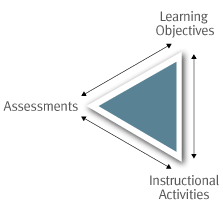
    course design triangle

    When we teach, we do not just teach the content, we teach students the content. A variety of student characteristics can affect learning. For example, students’ cultural and generational backgrounds influence how they see the world; disciplinary backgrounds lead students to approach problems in different ways; and students’ prior knowledge (both accurate and inaccurate aspects) shapes new learning. Although we cannot adequately measure all of these characteristics, gathering the most relevant information as early as possible in course planning and continuing to do so during the semester can (a) inform course design (e.g., decisions about objectives, pacing, examples, format), (b) help explain student difficulties (e.g., identification of common misconceptions), and (c) guide instructional adaptations (e.g., recognition of the need for additional practice).

  2. Effective teaching involves aligning the three major components of instruction: learning objectives, assessments, and instructional activities.

    Taking the time to do this upfront saves time in the end and leads to a better course. Teaching is more effective and student learning is enhanced when (a) we, as instructors, articulate a clear set of learning objectives (i.e., the knowledge and skills that we expect students to demonstrate by the end of a course); (b) the instructional activities (e.g., case studies, labs, discussions, readings) support these learning objectives by providing goal-oriented practice; and (c) the assessments (e.g., tests, papers, problem sets, performances) provide opportunities for students to demonstrate and practice the knowledge and skills articulated in the objectives, and for instructors to offer targeted feedback that can guide further learning.

  3. Effective teaching involves articulating explicit expectations regarding learning objectives and policies.

    There is amazing variation in what is expected of students across American classrooms and even within a given discipline. For example, what constitutes evidence may differ greatly across courses; what is permissible collaboration in one course could be considered cheating in another. As a result, students’ expectations may not match ours. Thus, being clear about our expectations and communicating them explicitly helps students learn more and perform better. Articulating our learning objectives (i.e., the knowledge and skills that we expect students to demonstrate by the end of a course) gives students a clear target to aim for and enables them to monitor their progress along the way. Similarly, being explicit about course policies (e.g., on class participation, laptop use, and late assignment) in the syllabus and in class allows us to resolve differences early and tends to reduce conflicts and tensions that may arise. Altogether, being explicit leads to a more productive learning environment for all students. 

  4. Effective teaching involves prioritizing the knowledge and skills we choose to focus on.

    Coverage is the enemy: Don’t try to do too much in a single course. Too many topics work against student learning, so it is necessary for us to make decisions – sometimes difficult ones – about what we will and will not include in a course. This involves (a) recognizing the parameters of the course (e.g., class size, students’ backgrounds and experiences, course position in the curriculum sequence, number of course units), (b) setting our priorities for student learning, and (c) determining a set of objectives that can be reasonably accomplished.

  5. Effective teaching involves recognizing and overcoming our expert blind spots.

    We are not our students! As experts, we tend to access and apply knowledge automatically and unconsciously (e.g., make connections, draw on relevant bodies of knowledge, and choose appropriate strategies) and so we often skip or combine critical steps when we teach. Students, on the other hand, don’t yet have sufficient background and experience to make these leaps and can become confused, draw incorrect conclusions, or fail to develop important skills. They need instructors to break tasks into component steps, explain connections explicitly, and model processes in detail. Though it is difficult for experts to do this, we need to identify and explicitly communicate to students the knowledge and skills we take for granted, so that students can see expert thinking in action and practice applying it themselves.

  6. Effective teaching involves adopting appropriate teaching roles to support our learning goals.

    Even though students are ultimately responsible for their own learning, the roles we assume as instructors are critical in guiding students’ thinking and behavior. We can take on a variety of roles in our teaching (e.g., synthesizer, moderator, challenger, commentator). These roles should be chosen in service of the learning objectives and in support of the instructional activities.  For example, if the objective is for students to be able to analyze arguments from a case or written text, the most productive instructor role might be to frame, guide and moderate a discussion.  If the objective is to help students learn to defend their positions or creative choices as they present their work, our role might be to challenge them to explain their decisions and consider alternative perspectives. Such roles may be constant or variable across the semester depending on the learning objectives.

  7. Effective teaching involves progressively refining our courses based on reflection and feedback.

    Teaching requires adapting. We need to continually reflect on our teaching and be ready to make changes when appropriate (e.g., something is not working, we want to try something new, the student population has changed, or there are emerging issues in our fields).  Knowing what and how to change requires us to examine relevant information on our own teaching effectiveness.  Much of this information already exists (e.g., student work, previous semesters’ course evaluations, dynamics of class participation), or we may need to seek additional feedback with help from the university teaching center (e.g., interpreting early course evaluations, conducting focus groups, designing pre- and posttests). Based on such data, we might modify the learning objectives, content, structure, or format of a course, or otherwise adjust our teaching. Small, purposeful changes driven by feedback and our priorities are most likely to be manageable and effective.

6 Effective Teaching Methods


6 EFFECTIVE TEACHING METHODS AND HOW TO USE THEM

We discuss 6 of the most effective teaching methods so that you can discover which teaching style suits you and your subject area best.

Teacher tests out different teaching methods on students

As we explored in our recent World Teachers Day blog post, teachers are a completely essential part of our society, but teaching can be a difficult and stressful job at times. 

Particularly when working with children and teenagers, it can be hard to retain focus, manage behaviour, and encourage active participation. In addition, teaching adults can have its own challenges – it can be difficult for adult learners to absorb new things and change old thinking patterns.

One thing that may help you deal with some of these challenges is learning about the different teaching methods available. You don’t need to pick one method and stick to it, but you may find that certain methods and styles are perfect for different learning environments. 

For example, you might find that student-centred learning is perfect for KS2 children, and game-based learning works wonders for KS3. You may discover that using technology such as VR can elevate history and geography lessons, while experiential learning methods can be effective during science experiments and group projects. To find out more, read about our top 6 most effective learning methods below.

1. Online learning

Teaching online may not have been the norm for most teachers before the COVID-19 pandemic, but there have always been some teachers who prefer to work online. Online tutors often enjoy the freedom of working from home, choosing their working hours, and being their own boss.

But what exactly does teaching online consist of? Essentially, it’s the process of educating others using the internet, whether that’s through individual or group video calls, webinars, or messaging platforms. Normally it’ll be a combination of things to keep students engaged.

If you’re thinking about teaching online, or your current job requires you to teach online, you’ll need to be comfortable with technology and the internet. This is because all of your communication will be online, and you’ll need to create digital resources for your students. These resources might be presentations, lesson plans, worksheets, videos or audio lectures.

The great thing about online learning is that it’s accessible to many people. Not everyone is able to go to school, but more people have access to the internet. Of course, technology can be a barrier to education too, but as the years go by, this barrier is, fortunately, breaking down.

The best place to start if you want to learn how to be an excellent online teacher is our highly rated How To Teach Online: Providing Continuity for Students course. You’ll learn how to successfully move from face-to-face teaching to online teaching so that you and your students get the most out of learning.

2. Experiential learning

If you haven’t heard of experiential learning before, it’s the idea that learning is a product of experience. If it sounds like something that you might be interested in, we have a whole article that explores how to apply experiential learning in the classroom and beyond.

We can only gain experience from interacting and engaging with the world and people around us. This learning theory comes from David Kolb’s experiential learning cycle, and considers the role of all our experiences in learning, from emotions and cognition, to our environment. 

Kolb’s 1984 theory suggests that there are four main stages in the learning cycle:

  • Concrete experience. This is when the learner has a new experience, such as riding a bike for the first time.
  • Reflective observation. After the concrete experience, the learner must reflect on their actions and watch others perform that action.
  • Abstract conceptualisation. The next step involves the learner making sense of their reflections and making a plan for going forward. They might come up with next steps and seek insight from experts.
  • Active experimentation. During the final stage, the learner will consider their reflections and previous lessons and then retry the original experience to see if any progress has been made. This will lead to a new concrete experience, and so the cycle restarts.

Experiential learning is a great teaching method because it encourages creativity, helps students learn from mistakes, fosters reflective thinking, and prepares students for future experiences. It can be effective for several subjects, especially during science experiments, sports coaching, and group projects. 

Some simple ways to encourage experiential learning in your classroom include encouraging students to assess themselves regularly and reflect on what they’ve learnt. As a teacher, you might want to record yourself teaching or keep feedback journals so that you can reflect on previous lessons. 

You can learn more about reflective practices in our open step by the British Council or delve into learning from experience in our open step by the University of South Wales.

3. Differentiation

Differentiated learning is a teaching method that tailors instructions to students depending on their individual needs. This method could be a great option if you’re teaching mixed-ability classes and want everyone to get the most out of each lesson. To become a pro at this teaching method, you can join our Differentiation for Learning course by STEM Learning.

This is a fairly traditional approach to teaching mixed-ability classes, but it can be successful if managed sensitively. For example, some teachers may choose to teach entirely different content depending on student ability. However, this can cause students to feel embarrassed and teachers to feel burned out from trying to do too much at once. 

On this note, it’s important for teachers to ensure that they create an inclusive classroom where students of all abilities are welcome, regardless of gender, race, sexuality or disability. Differentiated learning should never be used to make some students feel inferior to others.

A better way to approach differentiation is to teach in a variety of ways, including books, films, images, and verbal presentations. This gives different students the opportunity to get involved and understand the lesson content. You can even go further than that and offer differentiated class activities and assessment styles.

For example, if the class topic is a Shakespeare play, you could allow students to demonstrate their understanding in a number of ways. They could write an essay, give an oral presentation, create an illustration or comic, or play to any other strengths they have.

4. Blended learning

The next teaching method we’ll be exploring is blended learning. Essentially, blended learning is a combination of traditional face-to-face learning and technology-based learning. Although blended learning did exist before the COVID-19 pandemic, it’s become more popular with schools and universities in the two years. You can read all about it in our blended learning blog post.

Using a blended learning model can be great for both students and teachers because it forms a middle ground between traditional and technology-based methods. It uses enough technology to keep students focused and interested, but it also provides opportunities for students to talk in-person to teachers and fellow classmates, which can be invaluable. 

Some great examples of blended learning include:

  • Station rotation. Students rotate around different ‘stations’ during lessons, with these being a mixture of online and hands-on activities.
  • Flex learning. Students are in class with teachers, but they primarily use online learning methods. Teachers are there for support and instruction whenever needed.
  • Virtual Reality. Students are in a physical classroom but are able to use Virtual Reality (VR) to immerse themselves in an environment. This could be a historical landmark, art gallery, or natural wonder, with the aim of capturing their attention and furthering their learning.
  • Enriched virtual learning. Activities and coursework are completed online using digital technologies, but students can arrange face-to-face sessions when required.

It’s likely that blended learning models will become more predominant as time goes on and our physical and digital lives become increasingly interlinked. If you’re looking for a short course on the subject, you might be interested in our Blended and Online Learning Design course by UCL, or our Making Blended Education Work course by the University of Edinburgh and EMBED.

You may also be interested in our Introduction to HyFlex Learning and Teaching course by the University of Southern Queensland, Australia, which focuses on the innovative HyFlex teaching approach, a combination of hybrid and flexible methods.

5. Game-based learning

If you want to focus on making your lessons more fun, engaging and interactive, then look no further. Game-based learning, also known as gamification,  is a great way to engage students, particularly those in primary and secondary education. 

The definition of gamification is a strategy that implements game-like elements into non-gaming activities to enhance motivation. Since children are very interested in games, from video games and mobile applications to simple playground and board games, this can be a great place to start. 

As we explore in our blog post about gamification in education, playing video games has been linked to dopamine production. So, incorporating some ideas from video games into education can actually have positive effects on the mood of students, making them more determined to succeed.

However, it is worth mentioning that gamification shouldn’t necessarily be used in every context. Sometimes, lessons require more serious discussions. In addition, too much game-based learning is likely to remove some of the fun and increased motivation that children feel.

Here are some of the ways you can incorporate game-based learning into your lessons:

  • Points systems
  • Levels and progress bars
  • Challenges and competitions
  • Unique rewards
  • Learning badges

You can find out more about Learning through Play in our course by Federation University.

6. Student-centred learning

You can probably guess what this approach focuses on – your students. While the success and happiness of students is always a high priority for teachers, student-centred learning is different to more traditional teaching methods. 

Teacher-centred learning, which is more common, requires the teacher to give classroom instructions and lead the class for the majority of the time. With student-centred learning, students are given more opportunities to choose what they want to learn and how they want to learn it. This is also known as personalised learning.

In student-centred learning approaches, students are encouraged to take an active role in the classroom, rather than taking part in more passive activities like listening to a lecture or writing an essay. They will have lots of discussions with their peers and teachers, and they’ll also be encouraged to ask questions, which is linked to inquiry-based learning.

Some great examples of this kind of approach include students taking part in debates, small group projects, and fun roleplay scenarios together. As a teacher, it’s your job to be an excellent facilitator. You should encourage open communication, curiosity, creativity and exploration. At the end of a classroom activity, the teacher should urge students to reflect on what they’ve learnt.

    Final thoughts

    Hopefully, this list of effective teaching methods has given you some ideas to bring to the classroom. You’ll find further details on many of these topics, as well as many more, with our teaching courses. These can help you work on some of the skills that can improve your lesson planning and execution, benefiting you and your students.

    Flipped Classroom


    Flipped Classroom


    A flipped class is one that inverts the typical cycle of content acquisition and application so that:students gain necessary knowledge before class, and
    instructors guide students to actively and interactively clarify and apply that knowledge during class.

    Like the best classes have always done, this approach supports instructors playing their most important role of guiding their students to deeper thinking and higher levels of application. A flipped class keeps student learning at the center of teaching.


    Why are instructors flipping their class?

    Students learn more deeply.

    As a result of students taking responsibility, interacting meaningfully and often with their instructor and peers, and getting and giving frequent feedback, they acquire a deeper understanding of the content and how to use it.

    Students are more active participants in learning.

    The student role shifts from passive recipient to active constructor of knowledge, giving them opportunities to practice using the intellectual tools of the discipline.

    Interaction increases and students learn from one another.

    Students work together applying course concepts with guidance from the instructor. This increased interaction helps to create a learning community that encourages them to build knowledge together inside and outside the classroom.

    Instructors and students get more feedback.

    With more opportunities for students to apply their knowledge and therefore demonstrate their ability to use it, gaps in their understanding become visible to both themselves and the instructor.

    How do You Flip a Class?


    This guide is designed to walk you through the steps of flipping a single class; the process is scalable for flipping portions of each unit or an entire course. One of the major factors in course redesign is the time it takes to do it well. We recommend pilot testing the flipped model with a single class before engaging in a complete redesign.
    Step 1: Identify where the flipped classroom model makes the most sense for your course

    The following questions may help you identify a good place to start, whether you have designed your course around learning outcomes or by units:In which class sessions do you currently have an in-class activity that you rarely have time to complete during class and requires the students to apply their knowledge and skills?
    What concepts or topics do students struggle the most to understand, based on exam scores and/or assignment grades?
    On what topics would students benefit from the opportunity to apply concepts under your expert guidance in the classroom?

    Step 2: Spend class time engaging students in application activities with feedback

    The crux of the issue is figuring out for your class how class time could be repurposed in ways that provide students with an appropriate level of challenge while leveraging your expertise as a coach or guide. There are many possibilities for infusing a class with collaborative learning experiences. Utlimately, it comes down to finding an approach that works best for your students and your course content

    There are a wide variety of evidence-based instructional approaches that create engaging class environments, here are a few approaches being used to create collaboration and problem solving in small and large classes at UT:

    Peer Instruction: Students prepare for class and give instructors feedback about what they found confusing or difficult. During class, students experience cycles of mini-lectures interspersed with peer discussion of conceptual questions that work to elicit, confront, and resolve misconceptions students may hold. For more information, visit the Peer Instruction Blog.


    Team-based Learning (TBL): Students prepare before class and experience readiness-assurance quiz over the content at the start of class (first as individuals and then as a team). Teams get immediate feedback on their performance while instructors address gaps in understanding via mini-lectures. Next, teams engage in structured application activities that conclude with teams simultaneously making a specific choice. For more information, watch video about Team Based Learning (length: 12 minutes).


    Case-based Learning: Students work together in small groups with guidance from the instructor to analyze the problem and evaluate a given course of action or decide on one of their own. For more information, visit Case-based Teaching.


    Process-oriented Guided Inquiry Learning: POGIL activities are designed around the learning cycle where students explore data or information guided by questions, generate conclusions based on the data, and apply these concepts in new situations. The activities are structured to develop process skills, critical thinking, problem solving and collaboration. For more information visit POGIL.
    Assessment Strategies

    Assessment techniques can help inform and enhance learning when questions that measure student understanding are embedded into in-class learning activities:Provides students with feedback about what they know and do not know.
    Provides instructors with real-time data that informs instruction.
    Encourages students to engage during class by holding them accountable for their preparation.
    Leveraging Technology for Learning

    A Classroom Response System (CRS) allows instructors to ask questions to the class, then immediately gather and display student responses. There are many options on the market that offer a range of functionality depending upon what you are wanting to achieve. iClicker is supported by UT and popular option among our faculty. For information about how to get the most out of classroom response system, watch How to Use Clickers Effectively (length: 12 minutes).
    Step 3: Clarify connections between inside and outside of class learning

    The point of the Flipped Learning model is to move the application-oriented "homework" into the classroom and to move the "lecture" to before class. Here are a few questions to get you started in this process:What do I want my students to know and be able to do as result of completing this sequence of the course? How does it fit into the bigger picture of the unit and course?
    What part of the current "homework assignment" could be moved inside of class to help students practice applying the content? What in-class learning activity is being rushed because there is currently not enough time to do it well?
    What practice do students need inside of class to prepare them for the larger assignment that will be completed after class? Will students make the connection between what is happening inside of class and the assignment they are working on after class?
    What content do students need to know before class to successfully engage in the learning activity during class?

    The after-class portion may consist of a wide variety of activities including completing the work started in class or reading deeper about the topic or working together on a larger assignment that extends several class periods or practicing on one's own. Keep in mind that the after-class portion from the last class occurs at the same time as the before-class portion of the next class, so helping students manage the workload is important.
    Step 4: Adapt your materials for students to acquire course content in preparation of class

    The dynamic and active environment that is created within the flipped classroom, means that it is essential for students to come prepared for class. Once you have a clear idea of how students will be asked to apply their knowledge and skills during class, begin considering what students will need to read or view in advance. While online video content is associated with the Flipped classroom model, one can flip a class by repurposing traditional materials. Some common ways students prepare for class incude:Reading materials (e.g., textbook chapters or relevant articles)
    Online video and audio content (e.g., podcasts, videos, online micro-lectures, simulations, or demonstrations)

    Keep it simple at first by either relying on your current resources or using existing online content rather than creating your own. If you have time, explore what content currently exists online that may help you supplement your resources. Whatever path you take, make sure that you:Hold students accountable for completing the pre-class assignment, and
    Provide students a way to pose questions about the content they are learning outside of class.

    Step 5: Extend learning beyond class through individual and collaborative practice

    How will the content and skills learned before and during this class prepare students for extending their learning after class (e.g. finishing the problem set, starting work on a project or a portion of an assignment, building upon what was begun in class to delve deeper into the topic, practicing alone or collaborating with peers, etc.)?

    Students gain experience applying course content during class time, but they may also need additional practice after class. Extending what happens inside the class to outside the class is a crucial step for students to gain mastery and meet the learning outcome. Some ideas for deepening student understanding include:Use discussion boards or academic social media to elaborate on ideas developed inside class.
    Present additional problems (on Canvas, course website, or from the textbook) for students to gain further practice on their own outside of class. Online assessment systems can be used to provide immediate feedback to students.
    Create assignments that require students to take the skills and knowledge developed in class and apply it in a new way or to a new situation not covered in class.
    Assign additional readings that further expands upon the concepts discussed in class.
    Encouarage students to create informal learning groups.
    Develop a peer-led undergraduate study where students come together once a week to work additional problems that expand upon the concepts being learned in class.

    9 Teaching Methods


    9 Teaching Methods To Promote Success in the Classroom


    With the right teaching methods, educators can create an enjoyable and productive classroom experience for students where they can learn important academic and social skills to last a lifetime. There are many frameworks that a teacher could use to support students with different interests, abilities and learning styles. If you're a teacher or professional in the education field, you might benefit from learning about new instructive strategies in the field to maximize your students’ chances of success in your classroom. 

    In this article, we define what teaching methods are, explore nine types of teaching methods, review the benefits of these methods and provide some tips for doing so successfully.

    Key takeaways:

    • Teaching methods are techniques that educators can use to facilitate the teaching process and help students feel engaged and interested in the material. 

    • Types of teaching methods include differentiated instruction, lecture-based instruction, technology-based learning, group learning, individual learning, inquiry-based learning, kinesthetic learning, game-based learning and expeditionary learning.

    • Improve your teaching methods by testing different ones using the same lesson, meeting with other teachers to get their perspectives and remaining flexible. 


    What are teaching methods?

    Teaching methods are ways to instruct students in a classroom, helping them to understand and remember what they've learned. Some of the best teaching strategies allow educators to convey information in a clear and concise way while also ensuring students retain it over the long term. If students can comprehend facts on a deep level and practice skills properly in the classroom, they can apply that wisdom and those abilities to their personal lives and their future careers.

    Teaching methods are opportunities to make learning engaging, inspiring and fun for students. They aid teachers in fulfilling the responsibility of guiding the social and emotional development of children. By using the right strategies, teachers can instill values of respect, empathy and cultural sensitivity into their classroom. They also use teaching methods to prepare students for standardized testing. Your classroom philosophies and principles can vary based on your preferences as a teacher, your school mission statement, your subject areas and other factors.


    Types of teaching methods

    There are many kinds of procedures a teacher can use in a classroom. Many of them are similar in purpose, and educators can use a blend of instruction methods to best fit the needs of their students. Here are nine typical approaches to consider:


    1. Differentiated instruction

    Differentiated instruction is the idea of creating tailored education plans for students based on differing needs. This may involve the ways by which students access content, the activities they do, the assessment techniques a teacher uses or even the physical setup of a classroom. As all people have varying abilities and talents, it's beneficial for a teacher to adapt their teaching styles to unique students. This is also a key step in supporting students with disabilities in the classroom and ensuring they feel welcome and comfortable in academic environments. 

    Here are some ways an educator may differentiate instruction:

    • Provide books or other materials at different reading levels.

    • Create custom spelling lists for students with different spelling skills.

    • Host small groups to provide tailored advice to students.

    • Offer one-on-one after-school help to students encountering challenges.

    • Discuss student progress and at-home educational strategies with parents.

    • Measure progress in different ways, through projects, portfolios and participation.


    2. Lecture-based learning

    A traditional way to structure classroom learning is the lecture format, in which teachers explain information while students observe. Teachers lead a lesson by presenting on, showing visuals of and modeling examples of a topic. While a teacher is presenting, students can listen, watch, take notes and copy the teacher's demonstrations. While this is a conventional and helpful approach, teachers may alter it for different learning environments.

    Here are some ways that teachers ensure the success of lecture-based learning:

    • Keep lessons brief: Students, especially those at a young age, may have short attention spans and might only be able to focus for short periods of time. It can be advantageous to keep classroom lectures short and concise to maintain student attention and engagement.


    • Allow time for questions: While lecture-based learning is a teacher-centered approach, educators can still involve student input by making time for questions before, during and after the presentation. While this can make the lecture process longer, it can also allow students to engage with the material, comprehend it and remember it more easily.


    • Create instructional videos: Many teachers use a flipped classroom approach where they encourage students to watch lectures or instructional videos at home and complete assignments in class. This can be a great opportunity to let students work at their own pace, as they can see videos again by rewinding and replaying them.


    • Use visual cues: Whether in or outside of the academic environment, using visual cues in presentations such as icons, images and videos can be a great way to keep your audiences interested in the content. Make sure to use high-contrast colors and bold shapes and lines so students across your classroom can see and understand your messages.


    • Promote handwritten notes: For those students who are able, hand-writing notes on paper can be a superb way to stay focused during lectures. It can also help people to recall information well and strengthen their spelling and writing skills.


    3. Technology-based learning

    Teachers can use technology in the classroom to make teaching processes more efficient and aid in student learning. Students can use devices like computers and tablets to read materials, conduct research or play educational games. In addition, cloud computing capabilities make it possible for students to access documents or other resources while at school or at home. Virtual classrooms using video conferencing software can be a great way to provide education remotely. This can be especially helpful for students with disabilities who may have difficulties focusing in a physical classroom environment.


    4. Group learning

    Segmenting students into groups is a great way to teach them skills in collaboration. While in their teams, they can discuss subjects and learn about the perspectives of others. It's important to encourage both class participation and listening skills so that students can gain these abilities for the future. Teachers can assign group presentations so students can convey information to the rest of the class, ask and answer questions and interact with each other.


    5. Individual learning

    While group projects can be exciting opportunities for students, it's also important to promote individual learning so that they can work by themselves. Assigning journal entries can be an excellent way to give students time to think through topics and develop thoughts and analyses. This is especially helpful before hosting a class discussion so class members can have ideas for what to say. Teachers can read writing assignments to reward points to students who can't participate vocally in class.


    6. Inquiry-based learning

    Inquiry-based learning promotes the idea of learning by investigation, where students can complete projects, ask questions and find answers by themselves. While teachers act as resources in these times, the goal is for students to solve problems and discover information on their own. Upon learning about concepts, they can explain and present the concepts in their own words to further enforce them in their memories. Then, students can advance to higher levels at their own pace. This is a way for students to perform an active role in the learning process.


    7. Kinesthetic learning

    Kinesthetic learning is the notion of learning through movement. Teachers can move around the classroom and use hand gestures while they present to engage students visually and kinesthetically. They can also encourage students to perform physical activities where they can move around and use their creativity. Here are some ideas:

    • Drawing: Many students enjoy drawing or painting, and teachers can include this activity in the classroom to make learning enjoyable. Students can have the option to develop ideas and use different colors and tools to make their ideas a reality.


    • Acting: Students, especially young children, may have an exciting time developing and role-playing in theatrical performances. This can be a great idea for implementing kinesthetic learning in group projects.


    • Building: Building structures with blocks, toys or other materials can help students develop hand-eye coordination and analytical thinking skills. It can also be a fun way for them to stay focused in the classroom.


    • Playing: A traditional form of kinesthetic learning is playing sports, and many schools have gym classes where students can exert energy and spend time outside. You can also have educational sports games in the classroom, where students can move around and learn simultaneously.


    8. Game-based learning

    If you want to update your classroom techniques and help children to be more excited about learning, consider developing and implementing educational games or challenges, whether in-person or online. These can inspire children, especially kinesthetic learners, to participate more fully in the learning process and keep them motivated and focused on lessons. It can also allow them the opportunity to solve problems and reach a goal.


    9. Expeditionary learning

    Expeditionary learning is the process of learning through participating in practical experiences. These can be projects, case studies or lab experiments in the classroom or field trips to places around your school and community. For example, in a science class, you might take a trip to a nearby nature center to learn about the types of animals and plants in your area. This type of approach encourages students to apply classroom knowledge and skills to the real world. It can help them comprehend the purpose of their efforts and return to schoolwork with enthusiasm.


    Benefits of using teaching methods

    Using teaching methods can make the job duties of educators easier and more effective. Here are some benefits of this process:

    • Teaching your students effectively: You can use effective teaching methods that educators have been using throughout history to help people learn. Paying attention to the way you teach students, in addition to the content you convey to them, is a critical part of ensuring they master subjects and abilities.

    • Planning your educational content: In any career field, conducting the proper amount of planning and preparation can ensure your work is efficient and error-free. Planning your teaching methods for the day, week, month, quarter or year can support well-functioning lessons and classroom activities.

    • Finding the best ways to connect with your students: Experimenting with various teaching methods allows you to gauge what your students need and govern your classroom well. You can discover the teaching styles that lead to better performance on assessments and better progress reports.


    Tips for using teaching methods:

    With the right planning and sensitivity, many teachers can excel at using various instructional strategies in the classroom. Here are some tips for using teaching methods successfully:

    • Consult with more advanced professionals: Conduct research and consult with experienced teaching professionals to find inspiration for how you can operate your classroom effectively. You can also check with multiple people to confirm that your lessons are appropriate before implementing them to ensure their success.


    • Gain feedback from students and parents: In many schools, there are methods through which students and parents can give regular feedback to teachers about classroom techniques. Study this feedback carefully to adjust your approaches and meet student and parent needs.


    • Be adaptable: Stay open to trying new methods as your students grow, as you get new students and as times change. With the advance of technology and other tools you can use in the classroom, there are many ways you might improve your students' learning experiences.


    • Create a routine: An everyday routine, like a brief lecture, an individual writing assignment and a group activity every day, can keep the classroom predictable and comfortable for students. If students know what to expect, this can reduce stress and make them more ready to learn new information.


    • Teach the same topic in three different ways: Consider teaching key topics in multiple ways using a mix of methods to help students remember the information. For example, you might have them read about a topic, write about it and perform an interactive activity about it.