Showing posts with label Manufactruring Processes. Show all posts

Thursday, February 15, 2024

Study on RDBMS and its Application


EX NO:                     Study on RDBMS and its Application

DATE:

A Relational Database Management System (RDBMS) is a collection of programs and capabilities that enable IT teams and others to create, update, administer and otherwise interact with a relational database. RDBMSes store data in the form of tables, with most commercial relational database management systems using Structured Query Language (SQL) to access the database. However, since SQL was invented after the initial development of the relational model, it is not necessary for RDBMS use.

The RDBMS is the most popular database system among organizations across the world. It provides a dependable method of storing and retrieving large amounts of data while offering a combination of system performance and ease of implementation.

RDBMS vs. DBMS

In general, databases store sets of data that can be queried for use in other applications. A database management system supports the development, administration and use of database platforms.

An RDBMS is a type of database management system (DBMS) that stores data in a row-based table structure which connects related data elements. An RDBMS includes functions that maintain the security, accuracy, integrity and consistency of the data. This is different than the file storage used in a DBMS.

Other differences between database management systems and relational database management systems include:

·         Number of allowed users. While a DBMS can only accept one user at a time, an RDBMS can operate with multiple users.

·         Hardware and software requirements. A DBMS needs less software and hardware than an RDBMS.

·         Amount of data. RDBMSes can handle any amount of data, from small to large, while a DBMS can only manage small amounts.

·         Database structure. In a DBMS, data is kept in a hierarchical form, whereas an RDBMS utilizes a table where the headers are used as column names and the rows contain the corresponding values.

·         ACID implementation. DBMSes do not use the atomicity, consistency, isolation and durability (ACID) model for storing data. On the other hand, RDBMSes base the structure of their data on the ACID model to ensure consistency.

·         Distributed databases. While an RDBMS offers complete support for distributed databases, a DBMS will not provide support.

·         Types of programs managed. While an RDBMS helps manage the relationships between its incorporated tables of data, a DBMS focuses on maintaining databases that are present within the computer network and system hard disks.

·         Support of database normalization. An RDBMS can be normalized, but a DBMS cannot.


Features Of Relational Database Management Systems

Elements of the relational database management system that overarch the basic relational database are so intrinsic to operations that it is hard to dissociate the two in practice.

The most basic RDBMS functions are related to create, read, update and delete operations -- collectively known as CRUD. They form the foundation of a well-organized system that promotes consistent treatment of data.

The RDBMS typically provides data dictionaries and metadata collections that are useful in data handling. These programmatically support well-defined data structures and relationships. Data storage management is a common capability of the RDBMS, and this has come to be defined by data objects that range from binary large object -- or blob -- strings to stored procedures. Data objects like this extend the scope of basic relational database operations and can be handled in a variety of ways in different RDBMSes.

The most common means of data access for the RDBMS is SQL. Its main language components comprise data manipulation language and data definition language statements. Extensions are available for development efforts that pair SQL use with common programming languages, such as the Common Business-Oriented Language (COBOL), Java and .NET.

RDBMSes use complex algorithms that support multiple concurrent user access to the database while maintaining data integrity. Security management, which enforces policy-based access, is yet another overlay service that the RDBMS provides for the basic database as it is used in enterprise settings.

RDBMSes support the work of database administrators (DBAs) who must manage and monitor database activity. Utilities help automate data loading and database backup. RDBMSes manage log files that track system performance based on selected operational parameters. This enables measurement of database usage, capacity and performance, particularly query performance. RDBMSes provide graphical interfaces that help DBAs visualize database activity.

While not limited solely to the RDBMS, ACID compliance is an attribute of relational technology that has proved important in enterprise computing. These capabilities have particularly suited RDBMSes for handling business transactions.

As RDBMSes have matured, they have achieved increasingly higher levels of query optimization, and they have become key parts of reporting, analytics and data warehousing applications for businesses as well. RDBMSes are intrinsic to operations of a variety of enterprise applications and are at the center of most master data management systems.

How RDBMS works

As mentioned before, an RDBMS will store data in the form of a table. Each system will have varying numbers of tables with each table possessing its own unique primary key. The primary key is then used to identify each table.

Within the table are rows and columns. The rows are known as records or horizontal entities; they contain the information for the individual entry. The columns are known as vertical entities and possess information about the specific field.

Before creating these tables, the RDBMS must check the following constraints:

·         Primary keys -- this identifies each row in the table. One table can only contain one primary key. The key must be unique and without null values.

·         Foreign keys -- this is used to link two tables. The foreign key is kept in one table and refers to the primary key associated with another table.

·         Not null -- this ensures that every column does not have a null value, such as an empty cell.

·         Check -- this confirms that each entry in a column or row satisfies a precise condition and that every column holds unique data.

·         Data integrity -- the integrity of the data must be confirmed before the data is created.

Assuring the integrity of data includes several specific tests, including entity, domain, referential and user-defined integrity. Entity integrity confirms that the rows are not duplicated in the table. Domain integrity makes sure that data is entered into the table based on specific conditions, such as file format or range of values. Referential integrity ensures that any row that is re-linked to a different table cannot be deleted. Finally, user-defined integrity confirms that the table will satisfy all user-defined conditions.

Advantages of relational database management system

The use of an RDBMS can be beneficial to most organizations; the systematic view of raw data helps companies better understand and execute the information while enhancing the decision-making process. The use of tables to store data also improves the security of information stored in the databases. Users are able to customize access and set barriers to limit the content that is made available. This feature makes the RDBMS particularly useful to companies in which the manager decides what data is provided to employees and customers.

Furthermore, RDBMSes make it easy to add new data to the system or alter existing tables while ensuring consistency with the previously available content.

Other advantages of the RDBMS include:

·         Flexibility -- updating data is more efficient since the changes only need to be made in one place.

·         Maintenance -- database administrators can easily maintain, control and update data in the database. Backups also become easier since automation tools included in the RDBMS automate these tasks.

·         Data structure -- the table format used in RDBMSes is easy to understand and provides an organized and structural manner through which entries are matched by firing queries.

On the other hand, relational database management systems do not come without their disadvantages. For example, in order to implement an RDBMS, special software must be purchased. This introduces an additional cost for execution. Once the software is obtained, the setup process can be tedious since it requires millions of lines of content to be transferred into the RDBMS tables. This process may require the additional help of a programmer or a team of data entry specialists. Special attention must be paid to the data during entry to ensure sensitive information is not placed into the wrong hands.

Some other drawbacks of the RDBMS include the character limit placed on certain fields in the tables and the inability to fully understand new forms of data -- such as complex numbers, designs and images.

Furthermore, while isolated databases can be created using an RDBMS, the process requires large chunks of information to be separated from each other. Connecting these large amounts of data to form the isolated database can be very complicated.

Uses of  RDBMS

Relational database management systems are frequently used in disciplines such as manufacturing, human resources and banking. The system is also useful for airlines that need to store ticket service and passenger documentation information as well as universities maintaining student databases.

Some examples of specific systems that use RDBMS include IBM, Oracle, MySQL, Microsoft SQLServer and PostgreSQL.

RDBMS Product History

Many vying relational database management systems arose as news spread in the early 1970s of the relational data model. This and related methods were originally theorized by IBM researcher E.F. Codd, who proposed a database schema, or logical organization, that was not directly associated with physical organization, as was common at the time.

Codd's work was based around a concept of data normalization, which saved file space on storage disk drives at a time when such machinery could be prohibitively expensive for businesses.

File systems and database management systems preceded what could be called the RDBMS era. Such systems ran primarily on mainframe computers. While RDBMSes also ran on mainframes -- IBM's DB2 being a pointed example -- much of their ascendance in the enterprise was in UNIX midrange computer deployments. The RDBMS was a linchpin in the distributed architecture of client-server computing, which connected pools of stand-alone personal computers to file and database servers.

Numerous RDBMSes arose along with the use of client-server computing. Among the competitors were Oracle, Ingres, Informix, Sybase, Unify, Progress and others. Over time, three RDBMSes came to dominate in commercial implementations. Oracle, IBM's DB2 and Microsoft's SQL Server, which was based on a design originally licensed from Sybase, found considerable favor throughout the client-server computing era, despite repeated challenges by competing technologies.

As the 20th century drew to an end, lower-cost, open source versions of RDBMSes began to find use, particularly in web applications.

Eventually, as distributed computing took greater hold, and as cloud architecture became more prominently employed, RDBMSes met competition in the form of NoSQL systems. Such systems were often specifically designed for massive distribution and high scalability in the cloud, sometimes forgoing SQL-style full consistency for so-called eventual consistency of data. But, even in the most diverse and complex cloud systems, the need for some guaranteed data consistency requires RDBMSes to appear in some way, shape or form. Moreover, versions of RDBMSes have been significantly restructured for cloud parallelization and replication.


Tuesday, February 6, 2024

Diffusion Welding


1. DIFFUSION WELDING

Diffusion welding is a solid state joining process in which the strength of the joint results primarily from diffusion. Diffusion means movement of molecules or atoms from high concentration region to low concentration region.

In this welding process both the welding plates are placed one over other in high pressure and temperature for a long period of time. This high pressure force starts diffusion between interface surfaces. This diffusion can be accelerated by the application of high temperature. This temperature does not melt the welding plates. The temperatures of about 50-60% of melting temperature can be used in order to have a high diffusion rate between parts being joined.

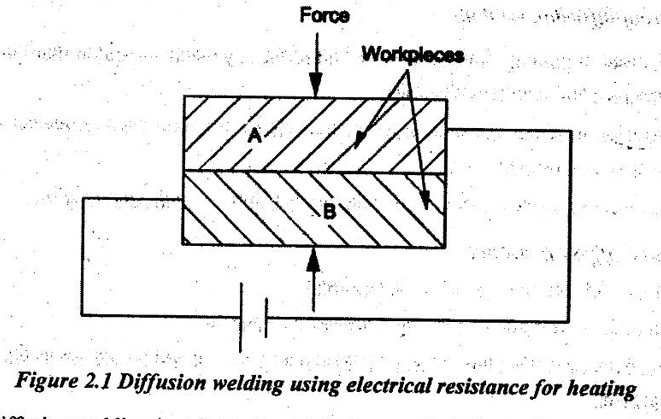
In diffusion welding, the pressure may be applied by dead weights or by a press using differential gas pressure. The parts are usually heated in a furnace or by electrical resistance. Figure 2.1 illustrates the diffusion welding process using electrical resistance for heating.

The strength of the welding depends on pressure, temperature, time of contact, and the cleanliness of the metal. The example for diffusion welding is bonding of gold over copper. First, a thin layer of gold foil is obtained by hammering. The gold is then placed over copper and then weight is placed on top of it. The assembly is then placed in a furnace and left until a good bond is obtained.


The diffusion welding is suitable for dissimilar metals. It is also used in reactive metals such as, titanium, zirconium and refractory metal alloys. The diffusion welding process is slower process when compared to other welding processes.

Working principle of diffusion welding:

First both the welding plate surfaces prepared for welding. In this process, both the interface surfaces made equally flat which is basic requirement of diffusion process. The interface surfaces should be machined, cleaned and polished well which remove all chemical contaminants from the surface. Any contaminant particle can be reduced diffusion between welding plates.

Now both the plates are clamped and placed one over another. This assembly placed into a vacuum chamber or in an inert environment. This protects the welding surface from oxidation.

A high pressure and temperature applied on this assembly to start diffusion. The temperature applied by the furnace heating or electric resistance heating. The high pressure is applied by a hydraulic press, dead weight or by the differential gas pressure. This conditions are maintained for a long duration of time for proper diffusion.

At the starting stage of this process, local deformation at the interface surface due to creep and yield take place. Now the diffusion takes place which form an interface boundary.

After a long period of time, both the plates properly diffused into one another which makes a strong joint. The interface boundary disappear which form a clean joint. This joint has same properties or strength as the base material.

Applications of diffusion welding:

1. It is used in joining of high-strength and refractory metals based on titanium in aerospace and nuclear industries.

2. Diffusion welding is usually used on sheet metal structures such as nuclear and electronics industries.

3. It is used to weld titanium, zirconium and beryllium metals and its alloy.

Advantages of diffusion welding:

1. Plastic deformation at surface is minimal.

2. There is no limitation in the thickness of workpieces.

3. The bonded surface has the same physical and mechanical properties as the base material.

4. This process produces clean joint which is free from interface discontinuity and porosity.

5. Both similar and dissimilar material can be joint by diffusion bonding process.

6. Running cost is less.

7. The diffusion bonding is able to help us to build high precision components with good dimension tolerance and hence precision components can be produced.

8. It can weld complex shapes.

Limitations of diffusion welding:

1. It is a time consuming process due to low productivity.

2. Very thorough surface preparation is required prior to welding process.

3. The mating surfaces must be precisely fitted to each other.

4. It is relatively high initial investments in equipment.

5. This process is not suitable for mass production.

Adhesive Bonding

 Adhesive Bonding is the process of joining two surfaces together, usually with the creation of a smooth bond. This may involve the use of glue, epoxy, or one of a wide range plastic agents which bond either through the evaporation of a solvent or through curing via heat, time, or pressure.

Bonding with adhesives is a very popular method of joining whose history dates back to 3000 years. It finds the application in assembly technologies very rapidly and extensively used in some of labeling, packing, book binding and foot wear. Its usefulness came into light during World War II when it was applied for assembling the load bearing components in aircrafts.


1. Adhesive and Types of Adhesives

Adhesive is a filler material that binds parts together. It is a non-metallic substance, mostly a polymer. The parts being joined are called “adhenands”.

Adhesives are very many in number. They can be classified as follows.

1. According to their function.

(a) Structural adhesives

They perform the mechanical load bearing function (e.g. Thiokol - automobile rear window adhesives)

(b) Holding adhesives

They can bear only limited loads but mainly form unstressed joints. (e.g. House hold appliance)

(c) Sealing adhesives we

They perform the function of excluding gases or liquids from a joint. (e.g. Caulking components).

2. According to chemical structure

(a) Natural adhesives (Starch and Dextrin)

(b) Inorganic adhesives (Sodium silicate and Magnesium oxychloride)

(c) Synthetic organic adhesives

(i) Thermoplastics

(ii) Thermosets.

3. According to the parts being jointed. 

(a) Metal - metal adhesive 

(b) Metal-plastic adhesive.

(c) Plastic glass adhesive.

4. Classification of synthetic organic adhesives:

(a) Chemically attractive (e.g. Polyethylene, epoxies, modified acrylic and phenolics, polyamides)

(b) Pressure sensitive (e.g. Natural rubber, butyl rubber, nitride rubber and polyacrylates)

(c) Hot melt (e.g. Polyester, polymides, polyolefins and other thermoplastic elastomers)

(d) Evaporative or diffusion (e.g. Vinyls, acrylics, phenols, synthetic and natural rubber)

(e) Elastically and thermally conductive (e.g. Epoxies, polyurethenes, silicones, Fillers such as silver, copper aluminium and gold are used to get electrical conductivity)

5. High temperature applications (up to 260°C)

(a) Polyimides

(b) Polybenzimidazoles.


2. Choosing an Adhesive

Choice of an adhesive is to be made taking into account various parameters. Some of them are as follows.

1. One-part adhesives are better than two parts. Two parts may result in improper metering and mixing human ignorance or negligence.

2. Tape and film adhesives are better than liquid and paste systems because of ease of handling. Also shrinkage problems are eliminated by resulting in strong bond.

3. Thermal expansion properties of metals being joined should be given utmost importance. If the difference of expansion is very high, the bond may fail.

4. Better to go for adhesives which are less critical about the cleanliness of the surfaces being joined.

5. Adhesives with harmful chemicals are to be avoided to protect human health.

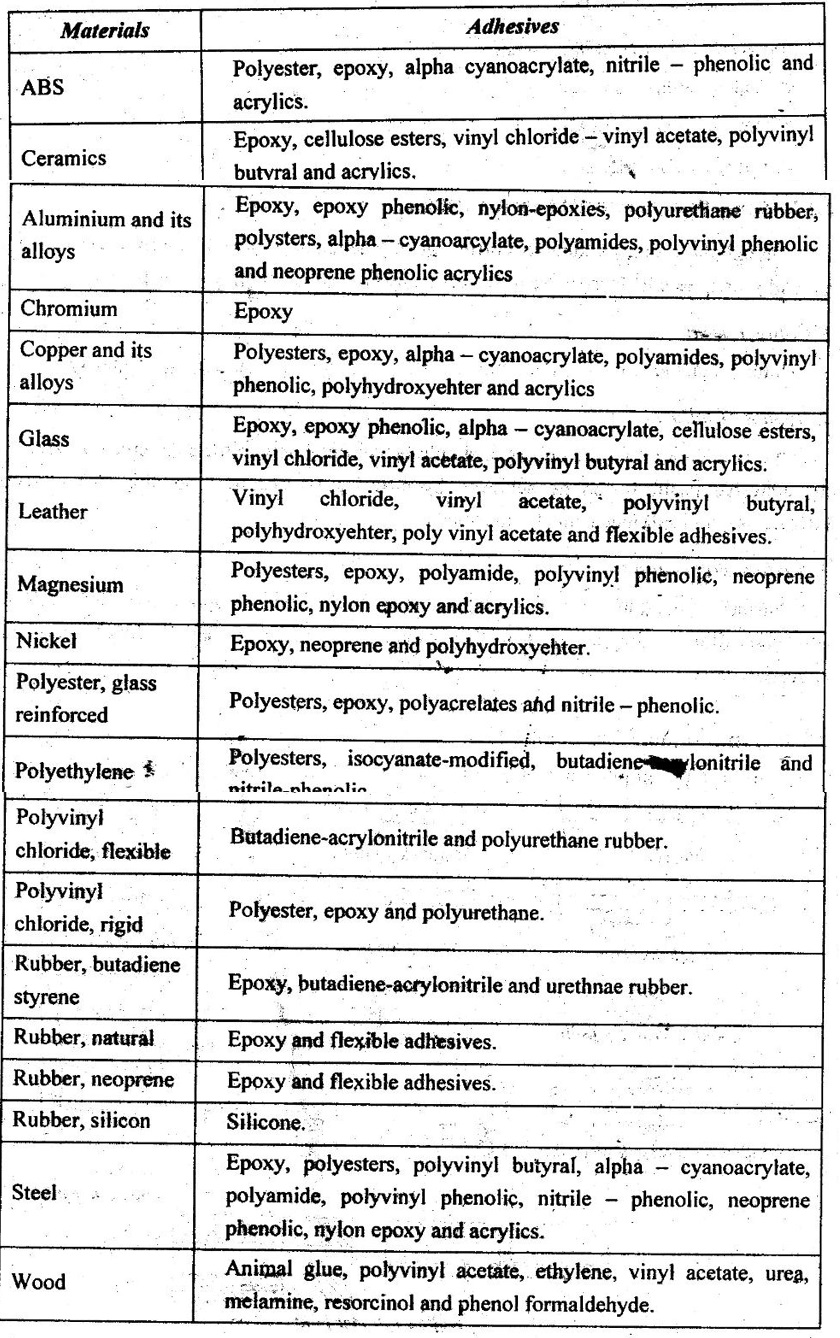
6. A single adhesive cannot perform in the same way in all cases. An adhesive which is perfect for metal-metal may not be so for metal-plastic. Table below shows some commonly used adhesives for various materials.


3. Some Principles of Adhesive Bonding

Though the choice of adhesives differs greatly depending on applications, there are some general principles which are to be followed in any bonded joint. They are as follows.

1. Contact area:

Joint contact area is to be maximum. It will result in more load carrying capacity.

2. Region of failure:

If a bonded joint failure occurs, it should be confined only to the adherents not affecting the adhesive itself. It can be achieved by ensuring (i) chemical bonding, (ii) physical interactions, and (iii) mechanical interactions.

3. Surface preparation:

Surface of the parts on which adhesive is applied is to be clean and free from dust, oil and oxide films. If they are present, they would hinder intimate contact between parts and adhesives.


4. Types of Adhesive Joints

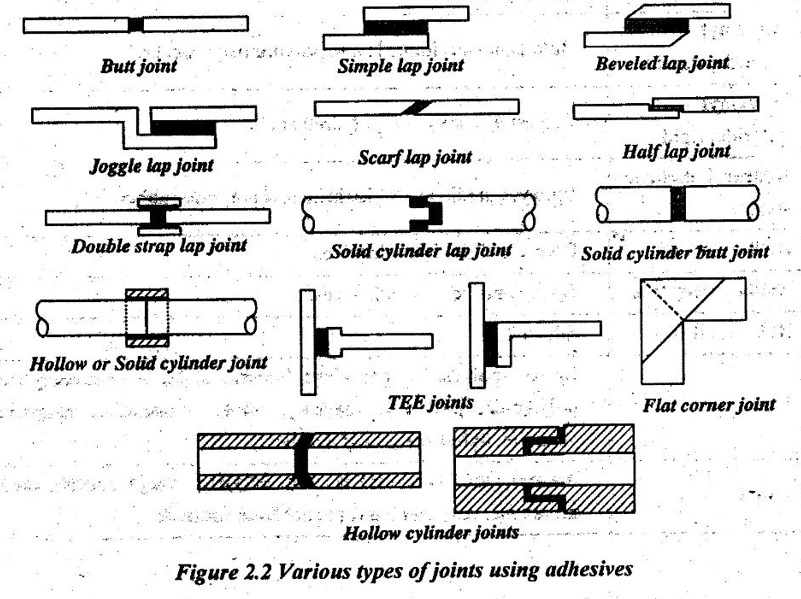
Various types of joints are used with adhesives. Some of them are shown in Figure 2.2.


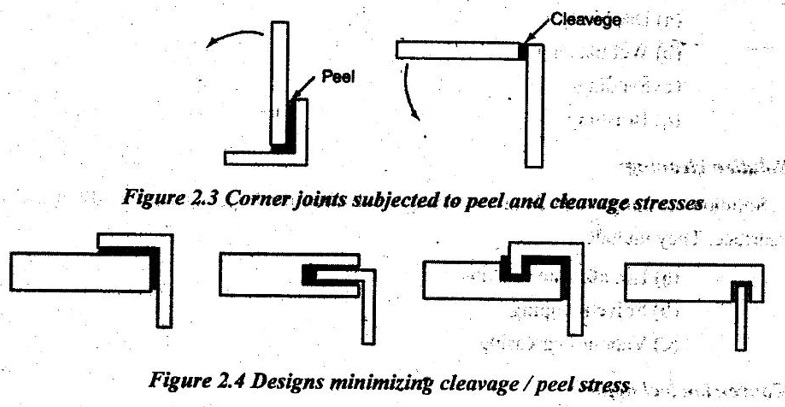
Particularly the corner joints may be subjected to peel and cleavage stresses if they are wrongly loaded as shown in Figure 2.3. Figure 2.4 shows some ways how to minimize those stresses.


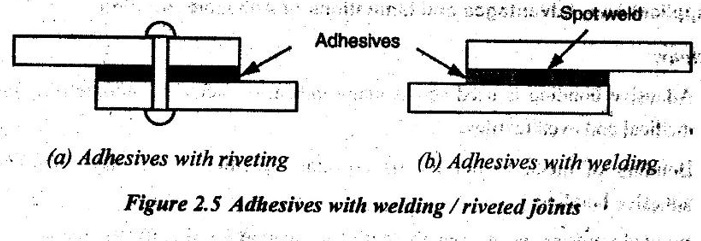
Adhesives with welding / riveted joints:

To overcome the cleavage/peel failure adhesives may be combine with traditional fastening methods such as riveting and welding. In the case of a rivet adhesive combination, the fatigue life of rivets is improved by the adhesive. On the other hand, rivets hold the ends of the bonds securely, thereby avoiding peeling. In the case of a weld adhesive combination, welding is done after the parts are jointed and cured by adhesive.


5. Surface Preparation for Adhesive Bonding

A foremost necessity in bonded joints is that the surfaces should be clean and free from any form of dirt. The possible impurities are water, metal oxides, adsorbed gases, lubricants and any such things. All these are to be removed and cleaned for getting a good durable joint. Some of the surface preparation methods are given below:

1. Abrasion:

Abrasion technique is used when the objects are large and thick layers of impurities are to be removed. They include:

(a) Dry blasting

(b) Wet blasting

(c) Sanding

(d) Brushing.

2. Solution cleaning:

Solution cleaning methods are normally used when the impurities are held loosely over the surface. They include:

(a) Hot alkaline washing

(b) Solvent wiping

(c) Vapour degreasing.

3. Conversion techniques:

In this technique, the impurities are removed using chemicals. The base metal is converted into a chemically different structure. They include:

(a) Anodizing

(b) Phosphating

(c) Chemical cross linking.


6. Applications, Advantages and Limitations of Adhesive Bonding

Applications:

1. Adhesive bonding is used across many industries including automotive, aerospace, medical and even textiles.

2. Bonding of metal to non-metals especially plastics is the major application of adhesive bonding.

3. Bonded joints are used as an alternative to riveting for aircraft structures.

4. Widely applicable in fastening of stiffeners to the aircraft skin and in assembling honeycomb structures in aircraft.

5. Extensively used in the fabrication of aircraft internal structures and providing the smooth surface for supersonic planes.

6. These joints are used in fabrication of railway coaches, boats, refrigerators, storage tanks, and microwave reflectors for radar and space communications.

Advantages:

1. The bond prevents electrochemical corrosion between dissimilar metals.

2. Vibration and noise are reduced because of internal damping provided by the adhesive.

3. Thin and fragile components can be joined without increasing the weight.

4. Stress concentration is minimized because the entire bond area is utilized.

5. Smooth contours are possible. Bolt, rivets heads or spot welds may increase wind resistance or make the component look unattractive. They can be reduced by using adhesives.

6. Easy assembling of parts.

7. Cost reduction may be achieved when used in combination with other joining methods.

Limitations:

1. They are not suitable for high temperature services.

2. Bonding and curing is a lengthy process.

3. Self-life of the adhesives is short and some may require special storage conditions such as refrigeration.

4. Surface preparation is essential.

5. Some adhesives may be toxic or inflammable. Thus, ventilation and fire extinguishing systems may be necessary.

6. It provides limited reliability.