Showing posts with label Transmission Systems. Show all posts

Wednesday, December 6, 2023

Difference Between Open Belt Drive and Cross Belt Drive


What is Belt Drive?

The belt drive is connected to two systems: The driver system and the driven system. The driver system is connected to the power source is called a driving system and the driven system to which rotation is transmitted is called a driven system.

Similarly, the pulley which transmits rotation is called the driving pulley, and by another one, the rotation is being transmitted is called the driven pulley.

The Open Belt drive and Crossed belt drive is one of the types of a mechanical power transmission system in which mechanical power is being transmitted in the form of rotational torque from one end driver shaft to another end driven shaft known as a machine unit.

These open and crossed belt drives come in the category of belt drive. And other such drives are Chain and Rope drive.

Initially, the pulleys of different diameters are firmly mounted on the shaft, and the belt is wrapped around the driver & driven pulleys maintaining proper tension to avoid slip. The friction force between belt and pulley helps transmit motion and power from one shaft to another.

The material used for these belt drives is a Leather belt, Nylon-Core belt, Cotton and Canvas belt, Balata Belting, Rubber on fabric belt, and Rubber belt.

Open Belt Drive:

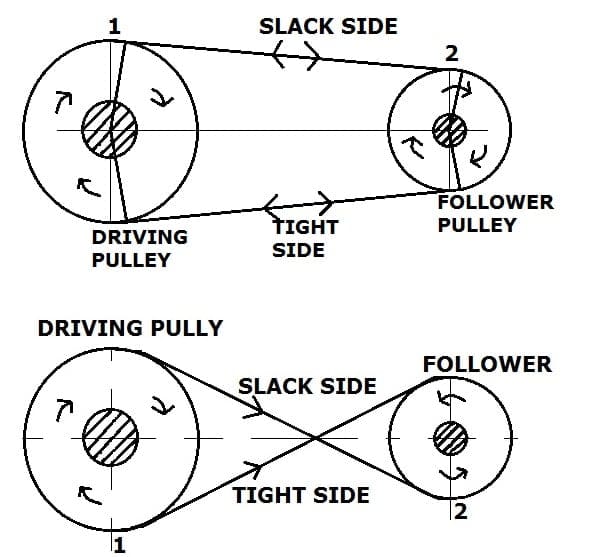
OPEN BELT DRIVE

In an open belt drive, the driver pulley and driven pulleys are in the same plane of the axis, and these rotate in the same direction.

It is best suitable for the condition in which both pulleys are in the same plane axis or little inclined.

Here the wrap angle (The angle between the belt & the Pulley) is always less than 180 degrees. Because of less wrap angle, it transmits less power.

Tight Side and Slack Side: When the pulley starts rotating, the belt is running over the pulley, the friction creates grip on the pulley on one side of the belt that makes the driven pulley run, this side is called tight side. And the side does not experience the same tension, that side is called the slack side.

And If the shaft has more distance between the driver and driven pulley then the upper side will be slack side and the lower side will be the tight side.

Cross Belt Drive:
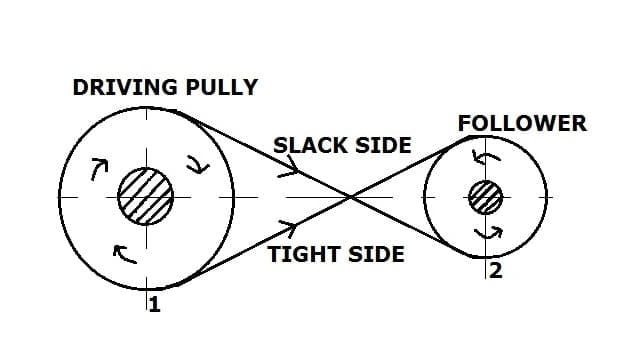
CROSS BELT DRIVE

The driver and driven pulley are not in the same plane of axis and both pulleys rotate in the opposite direction to each other.

Crossbelt is best suitable for the condition in which both pulleys are not in the same plane axis.

Here the wrap angle (The angle between the belt & the Pulley) is always more than 180 degrees. Because of the more wrap angle, it transmits more power.

Difference Between Open Belt Drive and Cross Belt Drive:

Here is the table of Open belt drive vs Cross belt drive:

Open Belt DriveCross Belt Drive
In an Open belt drive, the power transmission capacity is lower than the cross belt.In cross belt drive the power transmission capacity is higher.
In open belt drive, The angle of wrap is always below 180 degrees that’s why the power transmission capacity is low.Here The angle of the wrap is more than 180 degrees.
The main advantage of using an open belt drive is wear and tear of parts are low.Here wear and tears are more because belt crosses each other. It is one of the disadvantages of cross belt drive.
This open belt driver has a longer life because the belt does not touch itself therefore no rubbing takes place between them. WhereasA Crossbelt driver has shorter life compared to an open belt because the belt does touch itself therefore rubbing takes place between them that causes gradual wear.
The distance between the driver and driven pulleys is more therefore the chances of belt whips.Here there are no such problems with belt whips.
In an Open belt drive, there are also chances of slipping because of less angle of contact.In a cross belt drive, there are very few chances of slipping because of more angles of contact compared to an open belt.
The two pulley or shafts (Driver and Driven) rotates in the same direction. WhereasIn cross bet drive, these two pulleys rotate in opposite directions.
The entire belt remains in the same plane of axis in every rotation.But here the entire belt does not remain in the same plane of the axis. The belt bends in two different planes in every rotation.
The length of the belt is shorter compared to cross belt drive For the same pulley size and center distance.Here in cross belt drive The length of the belt is longer compared to open belt drive For the same pulley size and center distance.
When we increase the center distance of the open belt drive it vibrates.There is no such vibration here if we increase the same distance.
Difference between Open Belt and Cross Belt Drive
DIFFERENCE BETWEEN OPEN BELT DRIVE AND CROSS BELT DRIVE

Similarities Between open belt drive and crossed belt drive:


  • The power transmission occurs in both the cases by friction between the pulley and belt.
  • Slip occur in both the belt open and cross.
  • No one offer constant velocity ratio. Therefore we can say they are non-positive drive of belt.
  • In both (the open and cross belt) the flat belt is used. The other types of belt are V belt, Timing or Toothed Belt or Round Belt can not be used in crossed configuration.
  • Up to 15 meter both open and cross belt drive trnsmist power and motion. Unlike trapezoidal belt, V-belt which is suitable for short distance up to 1 meter only.

Belt Configuration:

The following belt configuration is as follows:

  • Bending of belt
  • Direction of rotation
  • Length of belt
  • Belt rubbing and Service life
  • Whipping of belt
  • Contact angle and
  • Power transmission

Monday, December 4, 2023

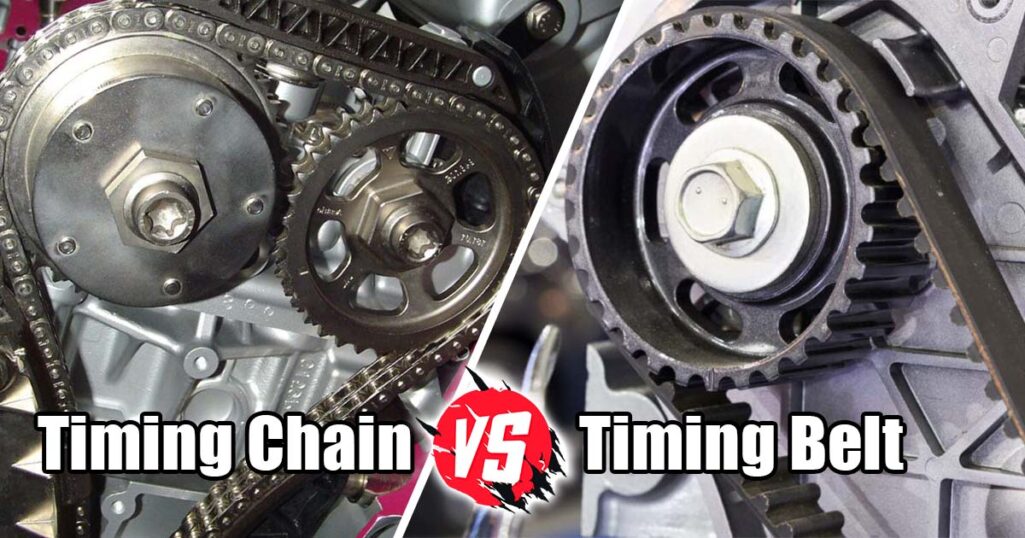
Timing Chain Vs. Timing Belt


Many individuals are not sure if there’s a distinction between timing chain versus timing belt, especially because they both have the same purpose in an engine system. They mistakenly believe they are the same.

Timing belts and chains are crucial elements of an engine that contribute to an engine’s smooth running, and every vehicle is equipped with either a timing belt or a timing chain. No vehicle has both.

Despite their comparable duty, there are significant distinctions between these two. That leaves you asking what may be the difference between a timing belt and a timing chain.

The Purpose of Timing

Simple explanation: timing belts and chains keep the fuel injection, air intake, and piston timing in harmony. Air and fuel should enter a piston as it goes downward.

An ignition spark plug then causes the gasoline to ignite, and the piston is pushed back down. As soon as it is done, the piston rises again to force the residual gas out of the engine and into the exhaust pipe.

In the blink of an eye, everything must come together in perfect harmony. Fuel injectors must be working while the crankshaft lowers the piston to ensure that the cylinder is filled with gas. Each of these parts is linked together by a timing belt or chain to control when the valves open to let air or fuel in relative to the pistons.

Engine damage might occur even if your timing is just a fraction off. Engine misfires can be caused by incorrect ignition timing, which results in unburned fuel. You’ll know something’s wrong when your car won’t start or idles strangely.

Watch this video to have a clear view of the engine timing and its importance:

Timing Chain

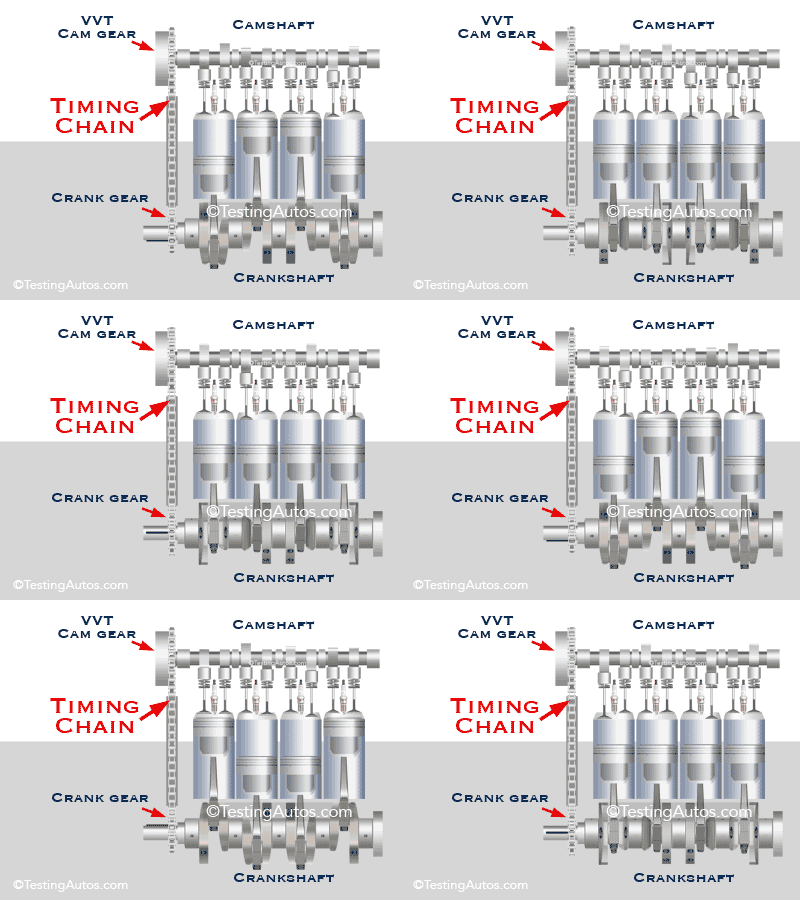
As a component of an internal combustion engine, the timing chain assists in keeping the camshaft and the crankshaft in sync, allowing the engine valves to open and close as needed during the exhaust and intake strokes.

In a cost comparison of timing chain vs. timing belt, chains come out on top (cost more), although they require less frequent maintenance. Aside from that, they aid in the operation of valves that deliver fuel to the combustion chamber.

In other words, the timing chain serves as a link between the top (valves and cylinder heads) and lower parts (crankcase and piston) of your vehicle’s engine.

The timing chain looks just like a bicycle chain and produces more noise than a timing belt. Proper valve timing and stroke timing in the cylinders of a car’s engine are critical to ensuring optimal engine performance, sufficient power delivery, and efficient fuel management.

Advantages of Timing Chain

Timing chains have a long lifespan:

The metal utilized to make it has a high level of durability.

Most manufacturers suggest that if you can maintain your engine properly, you may not need to replace your timing chain, which is true if you use the appropriate oil.

Doesn’t expand or elongate:

Timing chains are constructed of metal, so they don’t change in length or behave differently depending on temperature.

As a result, the chain tensioner is smaller, and the chain’s chances of breaking are minimal.

There is no slipping:

There’s no slipping involved with the timing chain, as there is with the belts.

Disadvantages of Timing Chain

Source: Nut Job / YouTube

Costly:

While a timing chain outlasts a timing belt, a chain is more costly than a belt.

Lubrication is required:

If you drive a car with low oil or a low-pressure oil pump, your engine may suffer. Your engine’s timing chain will last longer if you use high-quality engine oil.

Hydraulic pressure is necessary for chains to work:

Hydraulic pressure is required to operate the timing chains, which might sometimes be an issue.

Timing Belt

When compared with timing chains, timing belts produce less noise. With reduced friction, the piston and valves have less contact, preventing them from impacting one other.

The timing belt looks like a tooth or a circular belt with teeth on it.

Unlike the timing chain, a timing belt is constructed of rubber and fiberglass and performs the same duties as the chain. The camshaft is controlled by a belt attached to the ribbed gears at the ends of the cams and the crank.

Source: Brendma

The lifespan of a timing belt is less than that of a timing chain. They’re smaller, lighter, cheaper, and quieter.

The engine’s camshaft and crankshaft are linked by a timing belt, which allows the valves to open and close in time with the piston’s movement.

Advantages of Timing Belt:

  • It does not create a lot of vibration
  • High timing precision without sacrificing high-torque carrying capacity
  • Minimal noise produced
  • Rust-proof
  • It’s lighter
  • Much more affordable (No required lubrication, tensioning devices, and adjustments)

Disadvantages of Timing Belt:

  • You should replace your belt on a regular basis
  • For certain engines, it is dependent on the water pump
  • It requires more attention and maintenance

Conclusion

A timing chain is preferable to a timing belt if you don’t pick an engine model with a history of timing chain failures. As much as it may cost to replace a timing chain, the chances are that you’ll never have to do it again.

On the other hand, the timing belt will probably need to be replaced two or three times during the course of the vehicle’s lifespan.

Changing the timing belt three times can cost you more than $2,000. As a result, there is virtually no reason to use a timing belt in a modern car, as timing chains are becoming just as quiet as timing belts.

The most important thing to remember is to stay up with all of your service intervals, no matter which option you choose.