Showing posts with label Science and Technology. Show all posts

Sunday, December 17, 2023

Is The Butterfly Effect Real? And How Does It Work?


Edward Lorenz, a meteorologist, invented the term “butterfly effect” in the 1960s to describe his observation that even slight changes in a weather system’s beginning conditions can have enormous consequences. One well-known illustration of chaos theory is the “butterfly effect,” the belief that the movement of a single butterfly in Brazil might trigger a tornado in Texas.

The butterfly effect has been used in many different disciplines, from economics to psychology, in recent years, expanding its original scope beyond meteorology. The butterfly effect often illustrates how seemingly minor events may have far-reaching consequences in more intricate systems. This article will discuss the evidence for and against the butterfly effect as a scientific reality.

While it’s true that even seemingly insignificant actions can have far-reaching consequences, it’s pretty unlikely that a single butterfly could cause a noticeable shift in the weather. It’s not the best illustration, but it gets the point across and helps spark creativity.

When the Butterfly Effect Took Flight

50 years ago, on a cold winter day, Edward Lorenz, a mild-mannered professor of meteorology at MIT, entered some numbers into a computer program simulating weather patterns and then went to get a cup of coffee. Upon his return, he discovered a game-changing finding in the scientific community.

Twelve variables were used as the foundation for the computer model, each representing a different factor (such as temperature or wind speed). Those values could be plotted as an increasing or decreasing line over time.

Earlier in the day, Lorenz had run a simulation and was doing it again, but this time he rounded off one variable from .506127 to.506. That seemingly insignificant change dramatically impacted his program’s entire pattern, altering the simulated weather for two months.

The unexpected outcome prompted a profound realization for Lorenz about the workings of nature: minor adjustments can have significant results. Lorenz’s hypothesis that a butterfly’s wingbeat could trigger a tornado inspired the term “butterfly effect” to describe this chain of events. Further, a major implication of the butterfly effect, also known as “sensitive dependence on initial conditions,” is that accurate prediction of the future is often nearly impossible.

Lorenz’s impact was subtle at first but would have far-reaching repercussions, like flapping a wing. Lorenz summarized his study in a 1963 publication titled “Deterministic Nonperiodic Flow,” which was mentioned precisely three times in the next decade by scholars working in fields other than meteorology.

His discovery became the cornerstone of chaos theory, quickly gaining traction in the 1970s and 1980s across disciplines such as meteorology, geology, and biology. A professor of geophysics at MIT, Daniel Rothman, describes it as “a wonderful example of an apparently esoteric piece of mathematics that had experimentally verifiable applications in the real world.”

Lorenz’s work, as many scientists would realize by the 1980s, also posed a threat to the classical interpretation of the natural world. Similarly, French mathematician Pierre-Simon Laplace argued in his 1814 book A Philosophical Essay on Probabilities that if we knew everything about the current condition of the universe, “nothing would be uncertain and the future, as the past, would be present to [our] eyes.”

Butterfly Effect | Unsplash

In the deterministic universe described by Newton and Laplace, randomness has no place; as Lorenz once put it, “only one thing can happen next.” Every subsequent event is totally dependent on the current state of affairs. Lorenz’s own deterministic equations showed how readily the ideal of complete knowledge collapses under scrutiny.

Given the significance of this seemingly insignificant alteration to his simulation, it follows that the inherent uncertainty in every human measurement has the potential to be amplified into spectacularly inaccurate predictions.

Can a Butterfly in Brazil Really Cause a Tornado in Texas?

The idea that a butterfly’s wing in Brazil might trigger a chain reaction of meteorological phenomena that, weeks later, encourages the genesis of a tornado in Texas is poetic. This so-called “butterfly effect” is often cited as the reason why weather forecasts are only accurate up to a few days in advance for chaotic systems like the atmosphere.

Can a Butterfly in Brazil Really Cause a Tornado in Texas? | Live Science

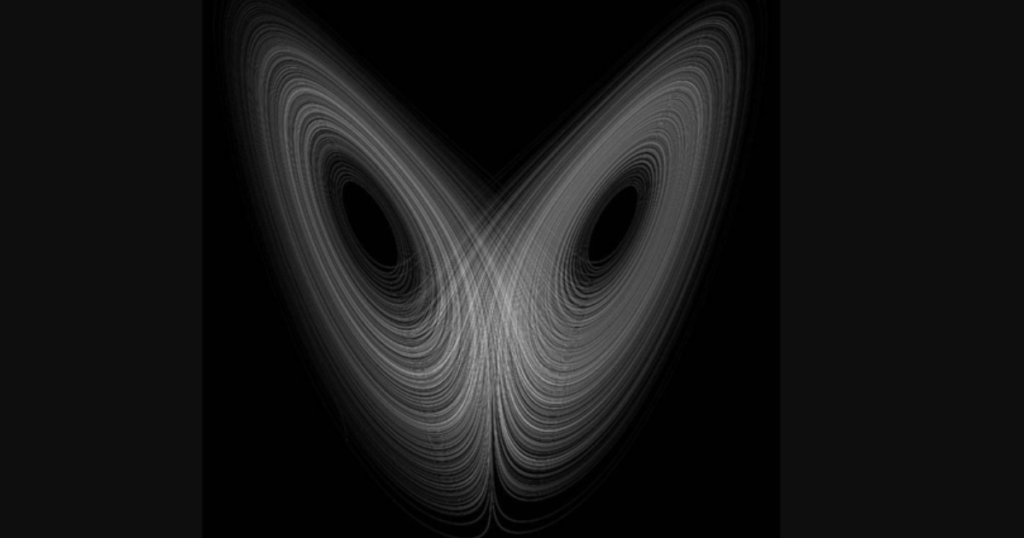
Knowing exactly when and where a storm would make landfall several days out would require knowing the precise details of every variable affecting the environment, which is impossible. The fact that the computer model that led to the discovery of the butterfly effect looks like a butterfly only adds to its appeal.

The model, developed in the 1960s by the mathematician Edward Lorenz, is a line that alternately spirals around two neighboring ovals. It represents the chaotic solution to a system of connected equations. Lorenz observed that the attractor’s shape was highly conditional. Simply shifting the origin by the width of a single scale on the wing resulted in an entirely new butterfly being drawn by the line.

Since the discovery of the strange attractor, the butterfly effect has been used to explain the emergence of chaos in various contexts, including the stock market and the Texas tornado season, among others. However, this is despite the fact that it is untrue: a butterfly in Brazil can flap its wings as much as it wants, but it still can’t create a tornado in Texas.

According to mathematician and author David Orrell’s interview with Life’s Little Mysteries, “If a butterfly flaps its wings, the effect really just gets damped out.”

Quantum Scientists Discover Inaccuracies in the Butterfly Effect

Scientists have debunked the butterfly effect at the quantum level, showing that past actions have no direct consequences in the present. The simulation pretends to send a piece of data back in time. The data gets subsequently corrupted.

However, when information is brought back to the “present,” it is largely unaltered, and counterintuitively, the final piece of information returns with less damage the further back it is taken.

Due to the impossibility of time travel, this effect is unique to quantum mechanics and the simulations made possible by quantum computers. “On a quantum computer, there is no problem simulating opposite-in-time evolution,” said Nikolai Sinitsyn, a Los Alamos National Laboratory theoretical physicist.

Butterfly effect in quantum realm | Discover Magazine

If we go back in time, make a minor alteration, and then come back, we can see what happens to a complicated quantum universe. The results showed that the world continues to exist, ruling out the possibility of a butterfly effect in quantum physics. To investigate the butterfly effect, the researchers employed an IBM-Q quantum processor equipped with quantum gates, which can simulate both forward and reverse causality.

The ‘bits’ used in the chips of typical computers and processors were binary digits, and they can only be in one of two states: “on” or “off.” Qubits, the quantum equivalent of a digital bit, can be on and off simultaneously or somewhere in between, making them ideal for quantum computers.

In the simulation, a person “time travels” by sending a qubit into the past. Measuring the qubit by a time traveler from the past disrupts it and modifies its quantum correlations. This is because a quantum-behaving atom can be jarred out of its quantum state by coming into even the slightest touch with another atom.

The simulation is then continued to bring the qubit up to date. It was discovered that the data was resistant to slight changes, contrary to the popular belief that data is irretrievable if even a single change is made (the “stepping on a butterfly” metaphor). Sinitsyn explained that the concept of chaos in classical physics and quantum mechanics requires distinct interpretations.

This finding has applications in both the testing of quantum devices and the concealment of information by transforming it into a quantum entangled state. Since in quantum mechanics, there is no such thing as a “butterfly effect,” if the simulation is running and the result is different, it would indicate that the quantum processor is not functioning correctly.

Case Study

Covid-19

Disease in a globally interconnected society, COVID-19, is a perfect example of how even a seemingly insignificant event can have far-reaching consequences. Given the interwoven nature of our globalized world, where it is impossible to prevent something happening in one country from spreading to another ones, some have speculated that a pandemic was inevitable.

As an example of the butterfly effect, investor Navindu Katugampola cites the development of COVID-19. It all started in a Chinese food market and has since spread to practically every major city around the globe. Because of our interconnectedness, a seemingly insignificant event has far-reaching implications.

Moreover, COVID-19 demonstrates how various sectors are interconnected as part of a larger system and how alterations in one area, such as health, can have knock-on effects on others, such as the economy, the mental health system, and the natural environment.

Individual Actions and Global Warming

The butterfly effect, as previously hypothesized, provides evidence that even seemingly insignificant actions can have a cumulative influence on the planet. There is no consensus on what will happen to Earth due to human activity. However, it is widely acknowledged that human activity has already significantly affected the environment and altered natural environments.

Although the Earth’s ecosystems are interconnected and complex, the butterfly effect reminds us that the actions of a single generation can have far-reaching and terrifying impacts on the entire system. The butterfly effect does not pretend to be able to trace how minor actions have greater repercussions, but it does show that what we do matters even if we may not be able to forecast exactly what would happen if we continue as we are.

The butterfly effect counters the conventional wisdom that we are doomed and that no one’s efforts can alter the course of climate change by suggesting that even seemingly insignificant actions can have far-reaching consequences.

Controversies

The widespread acceptance of the butterfly effect is not always accepted without question. The butterfly effect is often compared to the concept of leverage in common discourse. According to the book Team of Teams: New Rules of Engagement for a Complex World, this comparison is incorrect because it misrepresents the butterfly effect, which is the idea that a little change can have large-scale consequences.

This is because outcomes cannot be determined from starting conditions. Although seemingly insignificant events can have far-reaching consequences, predicting the precise link between such actions and their outcomes is extremely challenging, if not impossible.

While it’s true that seemingly insignificant actions can have far-reaching effects, it’s also true that they might not. Due to the unpredictability of chaos, the butterfly effect should not be interpreted as evidence that minor adjustments can significantly alter the course of events.

Furthermore, many economic models fail to account for the butterfly effect. Many standard economic models assume that consumers consistently exhibit predictable behavior patterns due to their clearly defined preferences. However, if the butterfly effect is real, it suggests that these models are wrong and perhaps no universal predictions of human behavior are possible.

While it would be extreme to throw out the concept of predictions altogether, the butterfly effect shows that causal relationships are not always straightforward and economic models may need to be adjusted to account for some uncertainty.

Sunday, December 10, 2023

Why don’t planes fly in a straight line on a map?


Source: Google Maps

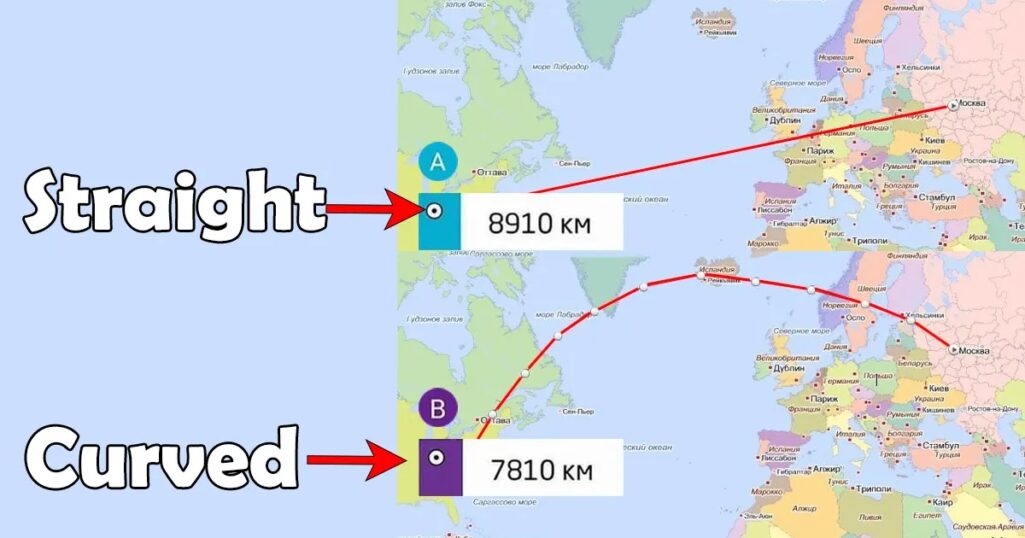
Have you ever noticed how airplanes travel over the map? If you had the opportunity to do so before, you most probably noticed the long route pilots take to reach their destination.

We all know that the shortest distance from point A to point B is simply a straight line. But why do all airplanes travel in what looks like a curved line? Why would a trip from the US to Asia have to pass through Greenland?

Source: Google Maps

THE QUICKEST WAY TO A PLACE IS NOT ALWAYS A STRAIGHT LINE

Source: gisgeography

Flying around the smaller circumference of the Earth is known as the “Great Circle Route.” It is particularly evident that trips from the United States to Asia will go well over Alaska and Siberia rather than what seems to be a straight line.

When you draw a line around a globe towards the middle, where it is broadest, rather than towards the North or South poles, the difference in the distance becomes evident, and it saves not only time but also fuel.

Geodesic lines are the lines that determine the shortest distance between two locations on a surface, although they aren’t always perfectly straight. A geodesic line always depends upon the surface itself.

Source: gisgeography

Geodesic lines connecting any two locations on a two-dimensional map are straight. But how does the land surface look on a curved map? Rather than being straight, the geodesic lines will be curved.

Also, because the Earth is not a true sphere (but obviously not flat!), and its poles flatten it slightly, we discover that geodesic lines are arches with varying degrees of curvature depending on the distance between two locations and the latitude difference between them.

Source: gisgeography

SO HOW DO THESE ROUTES GET ESTABLISHED?

Calculating an airplane’s quickest path isn’t so easy in reality. There are several variables to consider, such as the airspace limitations imposed by the various countries, the weather, the location of the various airports along the route, or the rotation of the Earth.

What is the Red Mixture that Planes Drop on Wildfires?


Almost every year, when temperatures start to increase, and the forests become dry, wildfires start to spread across the world. This problem has been increasing in recent years, and governments, along with many other organizations, are trying their best to counter the huge fire spread by multiple methods.

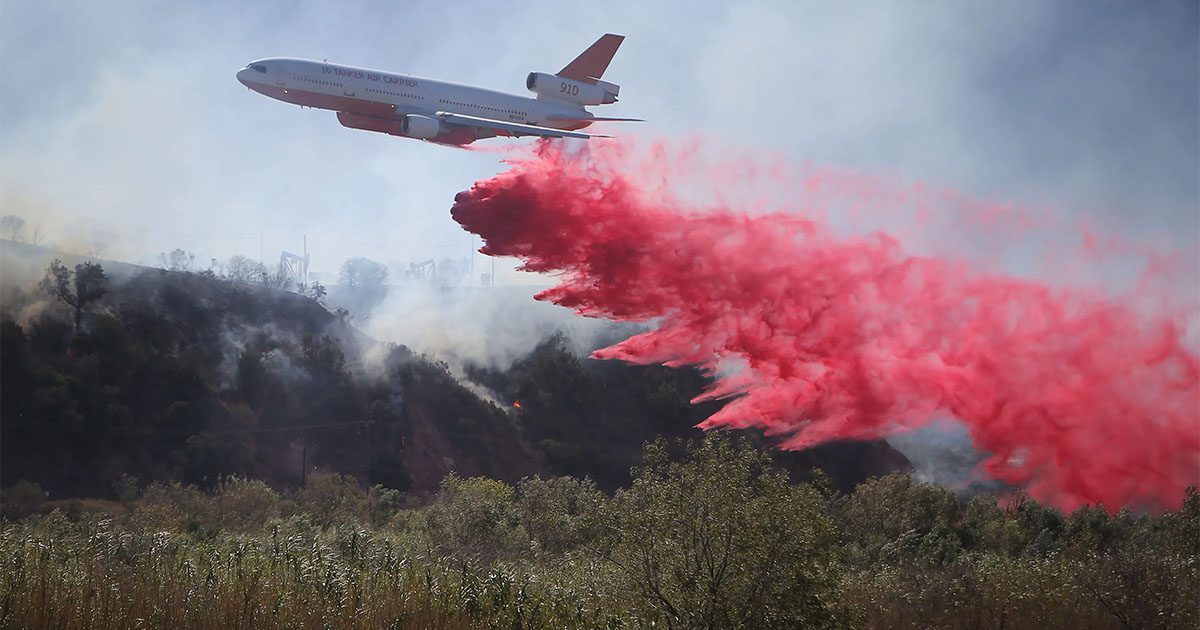
One of those methods is using airplanes, usually called Airtankers, to combat wildfires. These planes commonly use water to combat the wildfires, but sometimes they also use what looks like a “red water.”

If this was water, why is it red? What substances does it contain? And how do these substances help in extinguishing the fire?

Is it a Red Water?

Source: DAVID MCNEW/GETTY IMAGES

To answer this question directly, I would say No. This is not water at all! Neither does it contain water. It is completely a different thing.

This red “chemical” is a fire retardant that is used to combat huge wildfires that water alone can’t combat. This chemical has proved multiple times to be a game-changer against fire.

But why is it colored red? I hear you asking.

The short answer is that it is colored a bright red to make it visible from the ground and the air. Why? To make it easier for the firefighters so they can see where the chemical is covering the forest and where they still need to splash some more.

But why red?!

As we said before, it is just guidance for the firefighters to help them spot the chemical, and to do so, the color must be clearly different from its surrounding. Of course, they can’t color it green and spread it over a forest!

Is it better than water? You keep asking!

Firefighters often use water to combat fire since it’s readily available, relatively affordable, and typically successful in cooling and rendering combustible fuel. Yes, water is a great firefighting weapon, but it has one problem.

It doesn’t kill the fire completely! Yes, water takes time to counter huge and powerful wildfires, and with a vast, dry forest combined with strong wind, water is just not enough. Moreover, the fire could make a “come-back” even if the area has already been splashed by water.

In this case, a more powerful delivery system than a hose splashing water is required in order to prevent more fires from igniting.

What is this Red Chemical?

Source: JOSH EDELSON/AFP/Getty

As we said before, it is a fire retardant, and it is employed in aggressive wildfires to stop fires from spreading. This fire retardant is made by different companies, taking Phos-Chek as an example.

Phos-Chek is a major brand for that “red chemical” that is used in combating wildfires, as well as in residences and beneath fireworks displays. Despite the fact that this “red chemical” is not very dangerous, you still don’t want hundreds of gallons of it dumped on you from a plane.

What is the Composition of this Red Chemical?

Continuing with Phos-Chek as our example, the name of the product itself speaks of the composition. Ammonium “phosphate” is the active element in if, and its duty is to stop the flames.

How Does it STOP the Fire?

Source: Cal Fire

In contrast to water or firefighting foam, the long-term fire retardant is not intended for use on surfaces that are already on fire. So water should be used first to put out the fire, then the “red chemical” will be used.

It’s most commonly utilized to generate a chemical fire stop. Grass and other vegetation will not catch fire after being soaked with this red mud sludge.

There are also more uses for it besides putting out a wildfire. It is also used as a precaution in many places around the world. Let’s take the following example:

During its annual Fourth of July fireworks display, Pasadena in California employed eight tons of an uncolored variant of Phos-Chek fire retardant to protect heavily planted regions around the Rose Bowl and the Arroyo Seco.

Why uncolored? Because there is no need to track it. Because there is no actual fire, it is just a precaution.

Instead of being dropped from air tankers, the water and powder combination is sprayed from a tender water vehicle. Phos-Chek has kept many fires under control during the previous 20 years.

Many homeowners now request this method to protect their property and land. Many companies are providing this service. They will spray the uncolored chemical over your house or land to protect it from wildfire.

What do you think of this chemical? Would you use it to protect your house if you live in a place where wildfires are usual? Please leave your answers in the comment section below.

Monday, December 4, 2023

The discovery of fusion energy gets scientists one step closer to unlimited clean energy


Source: Hiden Analytical

Now and again, a patch of Oxfordshire becomes the hottest point in the solar system. And it was disclosed yesterday that the exhaust gases from this location — Britain’s main nuclear fusion experiment — can be made cold enough not to kill anything they come into contact with.

Scientists think they have achieved a crucial step toward near-limitless clean power by demonstrating that they can release the heat of waste plasma, enabling the creation of smaller, cheaper, and more efficiently nuclear fusion machines.

“It is a success in one of fusion’s most difficult challenges,” said Professor Ian Chapman, CEO of the UK Atomic Energy Authority. Fusion is an appealing target not only because it is clean but also because it has a high yield.

Nuclear fusion is the method through which the sun is powered. In contrast to fission, the reaction utilized in today’s nuclear power plants involves connecting rather than dividing atoms, resulting in nearly little radioactive waste. To make it operate, however, temperatures over 100 million degrees must be maintained.

Source: BBC Science 

Some of the superheated plasma must eventually be permitted to escape. If it does not have time to release its heat, it will rapidly blow its way through components.

This is one reason why Iter, the world’s largest prototype fusion reactor, is located in southern France. Scientists are generally positive that by the end of the decade, Iter will create ten times the amount of electricity required to run it.

Britain’s nuclear experts are working in Culham on a Mast Upgrade project to overcome the next problem: making reactors economically feasible.

Make the reactor smaller, and it will be less expensive. Smaller reactors have the benefit of requiring smaller magnets to keep the plasma in place. The catch, however, has been the exhaust, which is stretched across a smaller area in a smaller device.

Source: Handelsblatt

This is the problem, according to Chapman, that has been fixed. The Super X diverter, as it is known, employs additional magnets to channel the exhaust around an ever-widening spiral, allowing it to lose heat for 20 yards. The power output of the reactor drops from that of a rocket thruster to that of a car engine.

Many more issues must be addressed before this can be turned into a functional reactor. A fusion power plant will be among the most sophisticated devices ever constructed. It must not only safely confine the plasma but also produce its fuel and be maintained by robots because people will be unable to enter the chamber once it is operational.

However, Chapman believes that humankind has no choice but to make it work. By 2050, much of the globe will have achieved the objective of zero carbon dioxide emissions. “We vastly underestimate the magnitude of that challenge,” he said. “It’s simply the most massive challenge.”

The Secret Behind Not Flying Over South Pole!

Source: Half as Interesting / YouTube

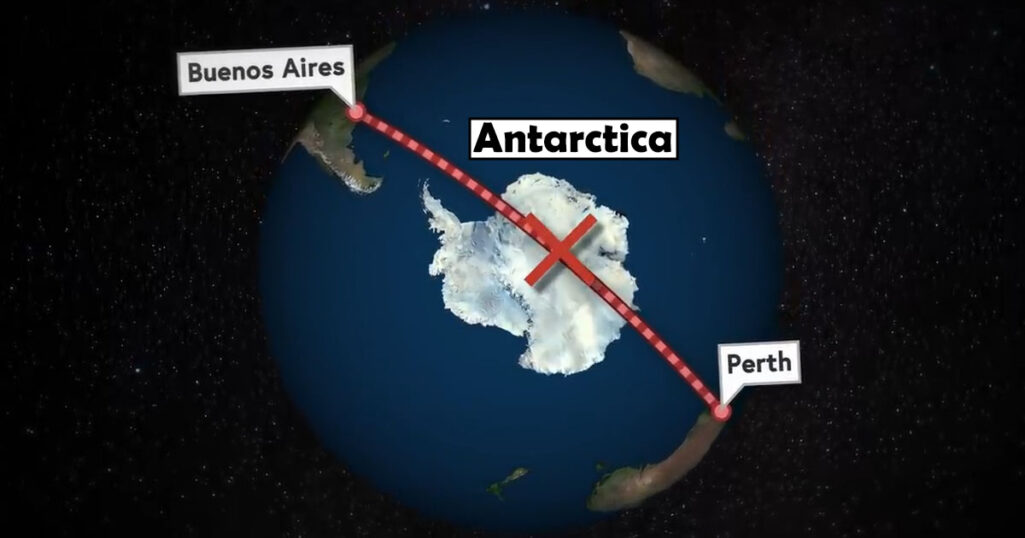
Antarctica or the south pole is the geographic South Pole of the Earth and is situated in the Antarctic region of the Southern Hemisphere. Planes usually don’t pass over Antarctica, even though they pass over the north pole.

So, for example, if you want to travel from Perth, Australia to Buenos Aires, Argentina non-stop, it seems logical to pass over Antarctica, but that doesn’t happen!

With the exception of some planes, almost all commercial flight trips don’t fly over the south pole.

On the other hand, trips like Dubai to Los Angeles, New York to Hong Kong, New Delhi to San Francisco all pass over the north pole in order to reduce the time of the trip.

But we don’t see this happening over the south pole. Why?!

There are several reasons for this, not the least of which is the fact that flying through Antarctica is not the most pleasant or safest option. But what makes traveling over the south pole that dangerous?!

To better understand why flying over Antarctica remains difficult for pilots, let’s take a closer look at some of the reasons.

1- Weather and Climate Conditions

Source: seasonsyear

In the most obvious sense, Antarctica’s climate isn’t exactly ideal for human activities. People who want to work in some of the harshest climates on the planet must undergo months of rigorous training before they arrive.

Only those who are either working or conducting research may be found in this area. Human settlements in Antarctica are primarily scientific facilities. Since this isn’t a popular tourist destination, planes rarely stop here for a pleasant stay.

Anti-icing methods, such as onboard electrical heating to keep the wings warm and melting ice, aren’t even taken into consideration. In order to prepare for a flight over one of the coldest areas in the world, you would need to go through all of this.

It’s also worth noting that even in freezing weather, there’s a short timeframe after de-icing a plane when it’s safe to fly. When flying over Antarctica, that window is likely to be negligible.

2- Poor Visibility

Source: sandiegoskytours

Then comes the reality that Antarctica isn’t the greatest spot in the world to see the sky. Not to mention that it is constantly impacted by snowstorms that may be extremely dangerous even in normal weather conditions.

It’s critical for pilots to keep their plane level and in good flying form at all times by staying in constant contact with the ground. When in the air, it’s incredibly dangerous to lose sight of where you are.

Besides that, pilots may encounter storms at any point in time. These can be difficult to cope with even in the best of circumstances, but in the Antarctic, they can be disastrous.

3- No Infrastructure

Source: Marc Bow/Hi Fly

Towers, airports, and other facilities that aid in takeoff, landing, and navigation are notably absent from Antarctica’s infrastructure.

Flying over Antarctica without a proper infrastructure may be like flying over an ocean. At the very least, flying over the ocean provides improved sight and previous flight routes, allowing pilots to better understand where they are going.

Antarctica is devoid of any of those. In the case of an emergency landing, you will have no assistance from anybody or anything as with the established flight paths.

4- Navigation Problems

Source: kathmandupost

Things only get more complicated from here on out. Because of the strong magnetic fields that surround the polar regions, navigating there can be particularly challenging.

The polar regions interfere with magnetic navigational equipment, making it harder for planes to navigate. It can also be difficult for planes to connect with flight controllers because of the location’s isolation.

Ensure you’re on the proper path and avoid any storms or other risks by checking your flight path before taking off.

As a result of all of these additional costs, the FAA has compiled a list of cold weather flying requirements that would be required if an aircraft were to fly over Antarctica. The following are the details:

  • You’ll need at least two “cold weather anti-exposure suits” on board to begin with. A thick coat and a few layers aren’t enough to keep you warm. Extreme weather is no match for these suits, which are specifically made to withstand it. These suits are, as you might assume, costly.
  • For the cold-weather location you’ll be going to, you’ll additionally require route-specific weather training. Because there are no flights over Antarctica, it is difficult to get “route-specific training” for routes that don’t exist.
  • Enhanced radios and other communication capabilities are also needed by aircraft so that they can keep in touch with air control towers. In the polar areas, this may be pretty challenging.
  • In the case of an emergency, you’ll need to come up with strategies to reroute to adjacent airports. There are no airports in Antarctica, let alone emergency ones; thus, this is a necessary precaution in freezing weather.
  • Finally, you’ll need to come up with strategies to keep the gasoline from freezing up.

What about the North Pole?

If flying over Antarctica is out, how about flying over the North Pole? There’s a bit of a complication there. It’s feasible to fly to the north pole despite the difficulties and rarity of doing so, but it’s not as easy as it seems.

Flight controllers might, for example, refer to previous polar flights for guidance while preparing and leading an Arctic flight despite their rarity and the fact that they are typically discouraged.

This is not the situation in Antarctica, which means that pilots and controllers would be flying blind if they attempted a mission there.

Additionally, if your jet has difficulties, it can land at two emergency airports near the North Pole. However, this is not the case in Antarctica, making it even more deadly to fly over there.

It has long been considered an adventure to visit Antarctica because of the severe climate and danger. A flying firm that is exploring how to tackle these issues and increase its flight paths over Antarctica will continue to face these challenges in the future.

However, for the time being, it is mostly an ice no-fly zone.

You could watch this video by “Half as Interesting” YouTube channel to know more on the topic:

Frequently Asked Questions

Q: Can you fly over Antarctica / South Pole?

A: For the time being, no commercial flights are allowed over Antarctica.

Q: Why don’t planes fly over Antarctica / South Pole?

A: Flying over Antarctica is not allowed due to the lack of landing infrastructure that is essential in any emergency status.

Q: Has anyone ever flown over Antarctica / South Pole?

A: Yes, In 1929, the Admiral Richard Byrd, an American explorer, and three companions made the first flight over the South Pole.

What is the Difference Between the South and the North Pole?

Source: Nasa

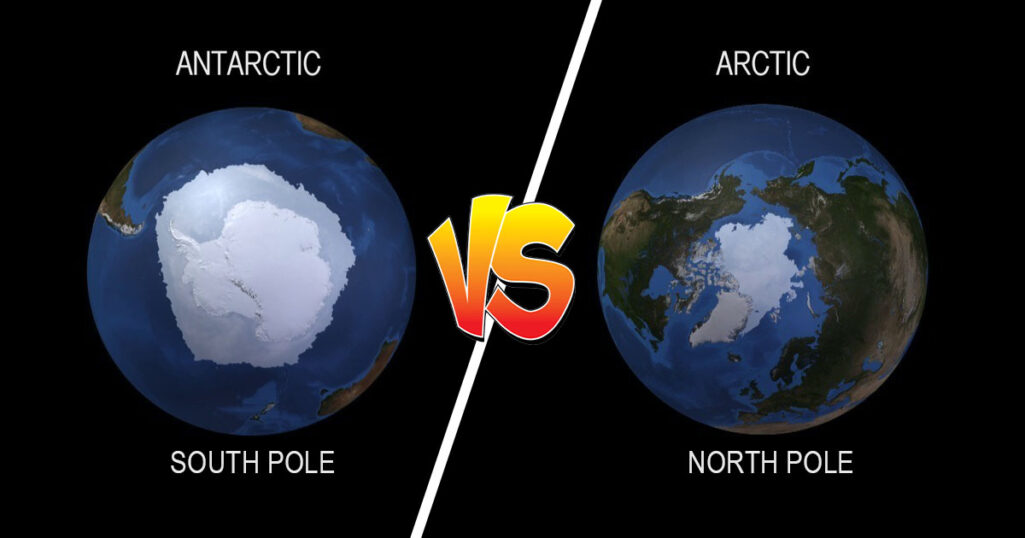
Arctic (North Pole) and Antarctic (South Pole) are separated by a remarkable 20,000 Km (12,500 miles), making them the two “ends of the world” on the planet. Even though these parts of the North and South Poles look the same, they offer visitors a variety of natural wonders that are very distinct from one another.

Source: Getty Images

Cold, snowy and untamed are the common characteristics for the extremities of our globe. The Arctic and Antarctic areas are very extraordinary if you can bear with the freezing cold temperatures.

From their diverse species to their breathtakingly rough terrain, each pole is jam-packed with exciting opportunities for exploration. Let’s find how different these poles are even though they look very similar.

Composition

Assuming you were standing at each pole and looking out across a vast area of white snow and ice, the perspective would be nearly identical, with few or no distinguishing characteristics to break up the picture. But in reality, the two landscapes are considerably distinct in composition.

The North Pole

Source: Getty Images

In the Arctic Ocean, the ice you’re standing on is between 1 and 3 meters (3-10 feet) thick and floats over seawater that has been frozen. The sea level is normally little more than 1 meter below your feet.

The North Pole is around 730 kilometers (450 miles) from the nearest land at Greenland’s northernmost tip.

It is impossible to accurately monitor temperatures in this area since there are no buildings or populations on the sea ice, and it is too unpredictable and unstable.

Source: Nasa

In reality, there is no such thing as a geographic North Pole. The Arctic is a large, open ocean that is encircled by land and covered by ice.

The South Pole

Source: Shutterstock

Standing over a block of ice that is 2,700m (9,000ft) thick, you are at an elevation of 2,835m (9,300ft). The ice extends down to rock that stands just over 100m above sea level, which is being forced into the Earth’s mantle by its own weight.

The ice is moving westward into the Weddell Sea at a rate of roughly 10 meters per year (33 feet), and the nearest ocean to the south pole is 1,300 kilometers (800 miles) away; it is the Bay of Whales.

Since 1956, a huge research station at the South Pole has been recording temperature readings.

Source: Daniel Leussler / wikicommons

Antarctica is a continent surrounded by sea ice and the Southern Ocean, with a thick ice sheet covering the whole surface of the continent.

Day and Night

From the March equinox until the September equinox, the sun is always above the horizon at the north pole, reaching a high point of 23.5° around June 21st of each year. It never rises over the horizon from September through March.

Source: CNNTwilight at the North Pole

On the other hand, the sun is at its peak at the South Pole on December 21st, which is summertime to the North Pole’s winter.

To make things clear: there are five months of daylight at the poles, followed by a month of twilight, followed by five months of darkness, and so on.

Wildlife and Nature

A wide variety of landforms may be found in the Arctic, such as plains, mountains, rivers, lakes, and vast areas of tundra and the edge of the world’s biggest ecosystem, the taiga.

TaigaSource: Daniel Leussler / wikicommonsTaiga

This frozen sea and neighboring landmasses are responsible for the ice in the Arctic Ocean. It has a lot of 3 to 4 meter-thick (10 to 13 foot-thick) multi-year sea ice, with some considerably thicker ridges. Greenland has the second-largest ice cover in the world after Antarctica, yet this permanent ice is extremely uncommon and tiny in area.

Even in the summer, the vast majority of the Arctic’s ice is solid sea ice, which forms as the Greenland ice sheet approaches the ocean’s edge.

The vast majority of Antarctica is covered in ice, which means that the terrain is dominated by snowy mountains, glaciers, or a smooth ice sheet. There are no big rivers or lakes that run year-round, minimal land vegetation, and no grass, bushes, or trees.

The Antarctic Peninsula has a few tiny sections of tundra, while several of the Antarctic and sub-Antarctic islands have greater areas.

The amount of Antarctica’s surface area doubles each winter due to the formation of sea ice along the coastlines, which breaks up and moves north in the summer, primarily melting as it does so. A large portion of the Antarctic seas, especially during the summer months, is composed of ice from glaciers and ice sheets.

Plants

North Pole plant

Plant life in the Arctic is dominated by what grows on the tundra, a huge low-growing treeless region of around 11.5 million km2. Low shrubs, sedges, grasses, mosses, and liverworts, as well as a large range of alpine-type blooming plants and numerous lichens, may be found throughout the area. The tundra is home to more than 1,700 types of plants.

Source: Sergey Gorshkov/NPLMusk oxen on Russia’s Wrangel Island in the Arctic Region

Many big herbivores, such as reindeer, musk ox, lemmings, arctic hares, and squirrels, may thrive in the tundra. Tundra plant cover can range from 80 to 100 percent near the southern tip of the arctic, whereas farther north, it can be 0 or only a few hardy alpines.

Source: Liam Quinn / flickrAntarctic mosses

On the other hand, the Antarctic is home to a far smaller variety of plants. Only around 1% of the continent is ice-free, mainly along the Antarctic Peninsula and on islands; however, there are some exposed rocks inland known as nunataks where the hardiest of plants may grow themselves.

Two kinds of plants, grass and a little flowering alpine, are all that are found, along with roughly 100 types of moss, 300-400 species of lichens, and 25 species of liverworts.

Animals

Source: Sky NewsPolar bears at the the north pole

Reindeer, musk oxen, lemmings, polar bears, and arctic hare are some of the major terrestrial creatures found in the Arctic, as well as arctic birds like the snowy owl and snowy tern. Animals can migrate south in the winter and return north in the summer months.

In sum, there are many of these creatures due to the vastness of the Arctic. Predators have to cover a big area to be able to feed themselves in the long run because the land isn’t particularly productive.

Source: Sarah Sonsthagen/USGSWalruses at the North Pole

Walruses and seals of many sorts, including bearded, harp, ringed, spotted, and hooded, are further examples of huge marine mammals found in the Arctic.

The smallest land animal found in Antarctica is a wingless midge insect, called the Belgica Antarctica, which is less than 1.3cm (0.5in) long. Because they’d be blown away, there are no flying insects.

Source: Tasteofcrayons/WikiCommonsBelgica Antarctica

A large number of penguins, such as Adelie, Chinstrap, Gentoo, King, Emperor, Rockhopper, and Macaroni, come ashore for most or all of their lives to feed on the sea’s resources. 

Fur, leopard, Weddell, elephant, crabeater seals, and many other kinds of birds such as albatrosses and assorted petrels could be found in Antarctica. In certain parts of Antarctica, the wildlife has grown to impressive numbers, thanks in part to the absence of human hunting.

Source: Greg BarrasLeopard seal resting on the sea ice in Antarctica

Human Presence

Source: Shutterstock

The Arctic (North Pole)

Source: Ansgar Walk / wikicommonsInuit women and child

The Arctic is home to a large number of native people. Inuits, Chukchis, Sami, Yupiks, and Inupiats all live there. One of the most notable contrasts between the two poles is humanity’s presence.

Source: northflashSami people

While most northerners are nomadic and hunter/gatherers, the Sami people of Scandinavia and other parts of Scandinavia are reindeer herders, making them an exception.

People have been living in the Arctic for several thousand years because of easy overland access from the south. This has had a profound impact on the region.

Source: russiatrekMurmansk, Russia

The biggest city in the Arctic, Murmansk, has a population of 325,100. The total population of the north pole is around 4 million people that live there permanently.

The Antarctic (South Pole)

No native communities have ever lived in Antarctica. Before 1820, no one had ever seen Antarctica, and it wasn’t until 1898 that the first Europeans spent a whole year there after setting foot on the continent.

Since the early days, Antarctica has only ever been inhabited by research stations and their workers, who only stay for a few months at a time. There are still no true natives of Antarctica who have lived there their entire lives and will continue to do so in the future.

Source: United States Antarctic ProgramMcMurdo American Base

The American base at McMurdo has the most residents, with up to 1,000 during the summer and only 250 during the winter. For 6 to 14 days each summer, ships bring 30-40k people to the continent.

Zero permanent population lives in the continent. The number increases in summer up to 45,000 and decreases in winter to a maximum of 1,000 people.

Climate Conditions

Polar locations have long, freezing winters and short, cool summers (or at least less freezing than the winter). However, there is a spring and fall, although you can miss them if you’re blinking too fast. One season is cold and bright, whereas the other is colder and dark.

The northern polar area and coastal regions are maintained reasonably warm even if they are covered by ice. This is due to the sea’s temperature, which does not go below -2°C.

However, at an average height of 2,300 meters (7,546 feet or 1.4 miles), making Antarctica the highest of all the continents, more than twice as high as Asia. And as we know, the temperature decrease by around 1°C every 100 meters of height. Imagine how freezing cold this part of the world is!

Additionally, the weather in Antarctica tends to stay within the continent, whereas Arctic weather flows out to the south. This will keep Antarctica colder than its Arctic neighbor since it doesn’t exchange weather with other places.

As the poles are so large and varied in temperature, it is impossible to put a number on how low each one is. However, we could provide a range of temperatures and the highest/lowest temperatures ever recorded there.

Temperature range recorded in January:

  • North Pole: Temperature ranges from -43°C to -26°C (-45°F to -15°F).
  • South Pole: Temperature ranges from -62°C to -55°C (-80°F to -67°F).

Highest temperature recorded at the poles:

  • North Pole: Highest temperature is +5°C (+41°F).
  • South Pole: Highest temperature is -13.5°C (+7.7°F).

On July 21st, 1983, the Russian station near the Southern Geomagnetic Pole in Antarctica reported the lowest temperature ever recorded on Earth: -89.2°C (-128.6°F).

Conclusion

The North Pole and the South Pole look very similar, but we have already shown in this article how different they are in reality. However, these are still some of the differences between the North and the South Poles that we discovered, but who said that’s all?

What more information do you have that we haven’t already stated? Please consider sharing your thoughts and information with us!