Showing posts with label Fluid Mechanics & Machinery. Show all posts

Friday, March 8, 2024

Solved problem on Pressure Measurement

 solved problem on pressure measurement: Fluid Properties and Flow Characteristics - Fluid Mechanics and Machinery

SOLVED PROBLEM ON PRESSURE MEASUREMENT

Example - 47

Express the pressure intensity of 0.7356 N/mm2 gauge absolute pressure in (i) KN/m2 of and (ii) in m of water.

Given data:

Gauge pressure = 0.7356 N/mm2

= 0.7356 × 10⁶ N/m2.

Solution:

Case (i) in KN/m2

Absolute pressure = Atmosphere pressure + Gauge pressure

W.K.T Atmospheric pressure = 1.014 × 10⁵ N/mm2

Absolute pressure = 1.014 × 10⁵ + 0.7356 × 106 

= 8.37 × 10⁵ N/m2

= 837 KN/m2

Absolute pressure = 837 KN/m2.

Case (ii) In m of water

Gauge pressure = 0.7356 × 10⁶ N/m2

Gauge pressure = 0.7356 × 10⁶ / 9810

= 74.985 m of water

W.K.T

Atmospheric pressure = 10.33 m of water

Absolute pressure = atmospheric pressure + gauge pressure

= 10.33 + 74.985

= 85.315 m of water

Absolute pressure = 85.315 m of water.

Result:

Case (i) Absolute pressure = 837 KN/m2

Case (ii) Absolute pressure = 85.315 m of water.


Example - 48

A gauge records a pressure of 24.52 KN/m2 in vacuum. Compute the corresponding absolute pressure in (a) KN/m2. (b) m of water. The local atmospheric pressure is 0.75 m of mercury; specific gravity of mercury is 13.6. 

Given data:

Vacuum pressure = 24.52 KN/m2

Atmospheric pressure = 0.75 m of mercury

Solution:

case (i) in KN/m2

Atmospheric pressure = 0.75 m of mercury

= (13.6 × 9810) × 0.75      (p = WH)

= 100062 N/m2

= 100.062 KN/m2.

Absolute pressure = atmospheric pressure - vacuum pressure

= 100.062 - 24.52

= 75.542 KN/m2

Absolute pressure = 75.542 KN/m2

case (ii) In m of water

Atmospheric pressure = 0.75 m of mercury

= 13.6 × 0.75

'= 10.2 m of water

Vacuum pressure = 24.52 KN/m2

= 24.52 × 10³ N/m2


= 2.4995 m of water.

Absolute pressure = Atmospheric pressure - Vaccum pressure

= 10.2 - 2.4995 = 7.7 m of water.

Absolute pressure = 7.7 m of water

Result:

Case (i) Absolute pressure = 75.542 KN/m2

Case (ii) Absolute pressure = 7.7 m of water


Example - 49

What is the gauge pressure in mm of mercury when the pressure at a point is (a) 85 absolute (b) 18 m of water absolute?

Given data:

Absolute pressure = 85 KN/m2 = 85 × 103 N/m

Specific weight of mercury = 13.6 × 9810 N/m2

Solution:


= 0.637 m of Hg

= 637.10 mm of Hg

Case (i)

Atmospheric pressure = 760 mm Hg

But absolute pressure = atmospheric pressure + gauge pressure 

Gauge pressure = absolute pressure - atmospheric pressure

= 637.10 - 760

= -122.9 mm of Hg


Case (ii)

Absolute pressure = 18 m of water
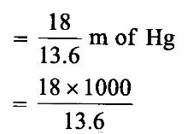

= 1323.53 mm of Hg

Gauge pressure = Absolute pressure - atmospheric pressure

= 1323.53 - 760


Result:

Case (i) Gauge pressure = 122.9 mm of Hg vacuum

Case (ii) Gauge pressure = 563.5 mm of Hg


Example - 50

Pressure Indicated by a column of water is 8.75 m what is the absolute pressure KN/m2. Take atmospheric pressure as 101.325 KPa.

Given data:

Water column H = 8.75 m

Absolute pressure Pabs = ?

Atmospheric pressure Patm = 101.325 KPa = 101.325 KN/m2

Solution:

Pabs = Patm + Pgauge

P = hw

Gauge pressure = 8.75 × 9810 N/m2 = 85837.5 N/m2

= 85.837 KN/m2

Result:

Gauge pressure = 85.837 KN/m2.


Example - 51

A gauge is fitted to a cylinder records a pressure of 24.52 KN/m2 vacuum compute the corresponding absolute pressure in (i) KN/m2 (ii) m of water. The local atmospheric pressure is 755 mm of Hg.

Given data:
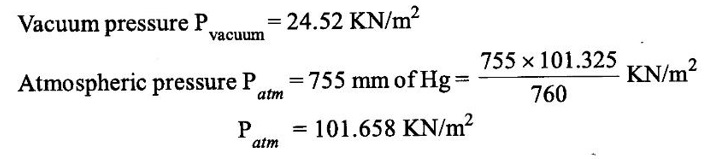

Solution:

Case (i) Absolute pressure in KN/m2

Pabs = Patm + Pgauge

= 101.658 - 24.52


Case (ii) Absolute pressure in m of water
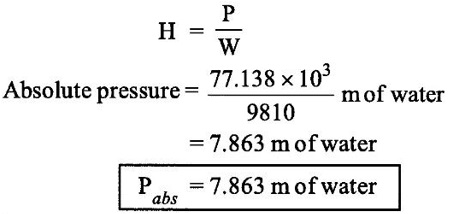

Result:

Case (i) Absolute pressure = 77.138 KN/m2

Case (ii) Absolute pressure = 7.863 m of water

Solved Problems on Pascals Law

 Solved Problems on Pascals law: Fluid Properties and Flow Characteristics - Fluid Mechanics and Machinery

Solved Problems on Pascals law

Example - 52

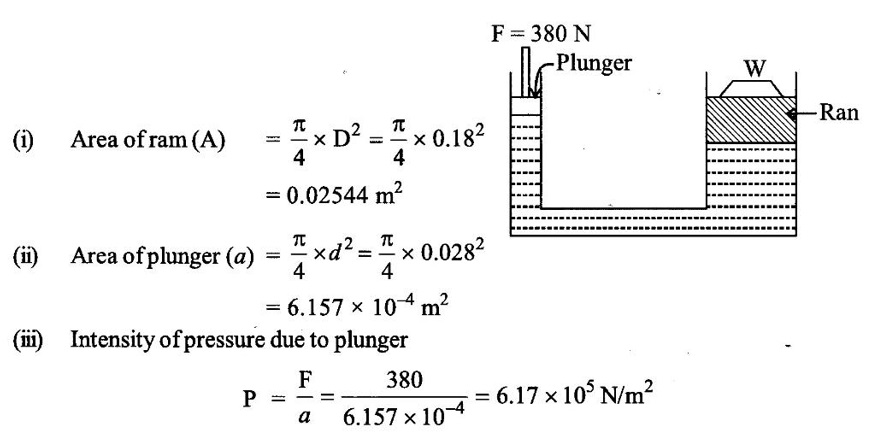
The diameters of ram and plunger of an hydraulic press are 180 mm and 28 mm respectively. Find the weight lifted by the hydraulic press when the force applied at the plunger is 380 N.

Given data:

Diameter of ram D= 180 mm = 0.18 m

Diameter of plunger d = 28 mm = 0.028 m

Force on the plunger (F) = 380 N.

To find:

Weight (W) = ?

Solution:


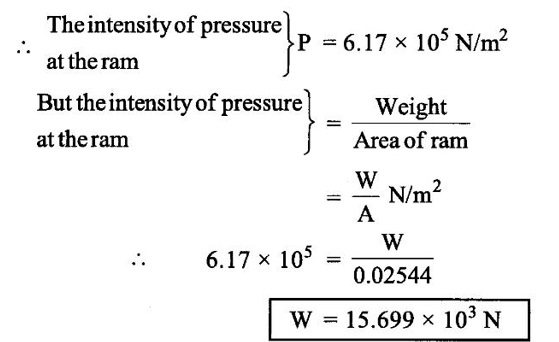
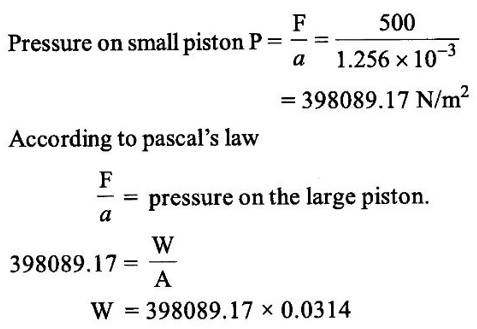
In pascals law the intensity of pressure will be equally transmitted.


Result:

Weight lifted by hydraulic press W = 15.699 × 10³ N

W = 15.699 KN


Example - 53

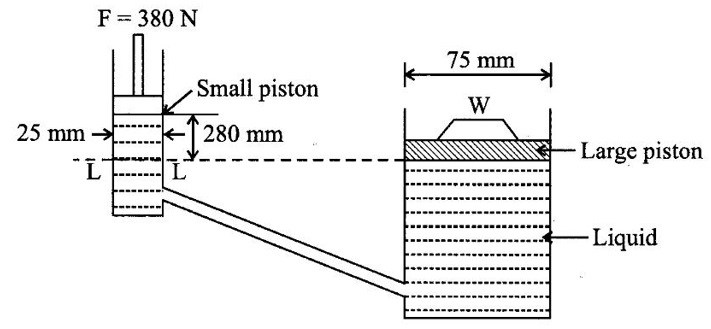
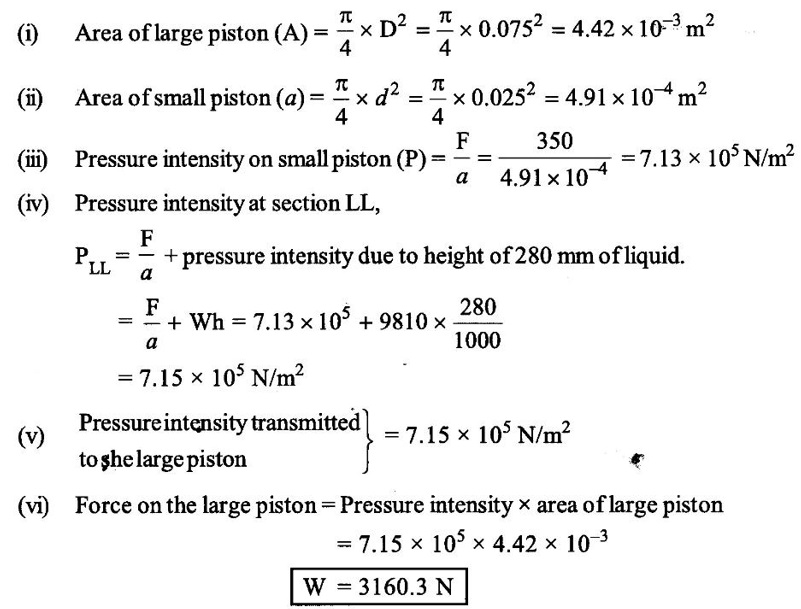
For the hydraulic Jack as shown in figure, find the load lifted by the large piston when a force of 350 N is applied on the small piston. Assume the specific weight of the liquid in the Jack is 9810 N/m3.


Given data:

Force (F) = 350 N

Ram diameter = 75 mm = 0.075 m

Piston diameter = 25 mm = 0.025 m

To find:

Load lifted (W)

Solution:


Result:

Load lifted (W) = 3.16 KN.


Example - 54

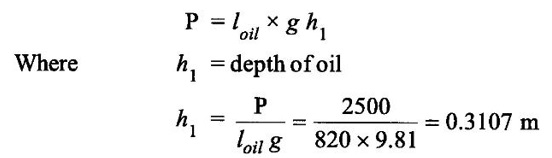
Find the depth of oil of specific gravity of 0.82 which produces an intensity of pressure equal to 2.5 KN/m2. Also find the pressure head in terms of water and mercury.

Given data:

Specific gravity of oil (S) = 0.82 

Intensity of pressure (P) = 2.5 KN/m2

To find:

Pressure head (h)

Solution:

Density of oil (loil) = specific gravity of oil × density of water

= 0.82 × 1000 = 820 kg/m2.

Intensity of pressure (P) = 2.5 KN/m2 = 2.5 × 1000 N/m2

= 2500 N/m2

Now intensity of pressure


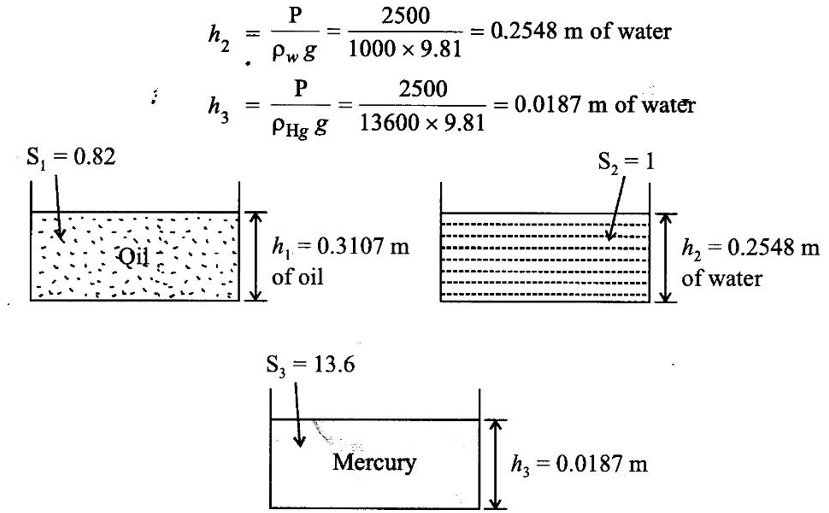
Now assume h2 and h3 are the pressure heads of water and mercury respectively of same intensity of pressure (p).

Result:

(i) Pressure head h1 = 0.3107 m of oil

(ii) Pressure head h2 = 0.2548 m of water

(iii) Pressure head h3 = 0.0187 m of Hg.


Example - 55

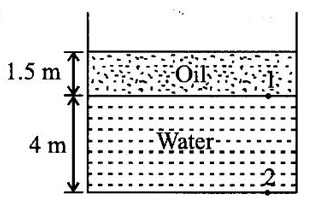
An open tank contains water upto a depth of 4m and above it an oil of specific gravity 0.9 for a depth of 1.5m. Find the intensity of pressure.

(i) At the interface of the two liquids

(ii) At the bottom of the tank.


Given data:

Height of water h1 = 4 m

Height of oil h2 = 1.5 m

Specific gravity of all s1 = 0.9

To find:

Pressure intensity at interface at point 1 and 2.

Solution:

case (i) pressure intensity at the interface of the two liquids at point 1 

P1 = ρ g h2 = 900 × 9.81 × 1.5

= 13243.5 N/m

P1 = 13.243 Kpa

case (ii) pressure intensity at the bottom @point 2

P2 = (ρ g h2)oil + (ρ g h1)water

= P1 + (egh1)water

= 13243.5 + (1000 × 9.81 × 4)

= 52483.5 N/m2

P2 = 52.48 KPa

Result:

(i) Pressure at the interface of the two liquids = 13.243 KPa

(ii) Pressure at the bottom = 52.48 KPa


Example - 56

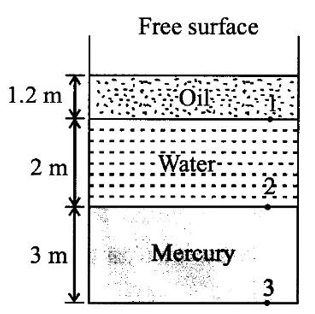
An open tank contains mercury upto a depth 4m and above of water upto a depth 2m and above water an oil of specific gravity 0.92 for a depth of 1.2 m. Find the intensity of pressure

 (i) At the interface of the oil and water 

(ii) At the interface of water and mercury 

(iii) At the bottom of the tank

Given data:

Height of mercury h1 = 3m

Height of water h2 = 2m

Height of oil (h3) = 1.2 m

Specific gravity of oil (soil) = 0.92


To find:

(i) Pressure at interface of oil and water (@point 1)

(ii) Pressure at interface of water and mercury (@point 2)

(iii) Pressure at the bottom of the tank (@point 3)

Solution:

case (i) Pressure at interface of oil and water

P1 = (ρ g h3)oil

= 920 × 9.81 × 1.2

= 10830.24 N/m2

P1 = 10.83 KPa

case (ii) Pressure at interface of water and mercury

P2 = (ρ g h3)oil + (ρ g h2)water

= P1 + (1000 × 9.81 × 2)

= 10830.24 + 19620

= 30,450.24 N/m2

P2 = 30.45 KPa

case (iii) Pressure at the bottom of the tank

P3 = (ρ g h3)oil + (ρ g h2)water + (ρ g h1)Hg

= P2 + (ρ g h1)Hg

= 30.45 + (13600 × 9.81 × 3)

= 30.45 + 400248

= 430698.24 N/m2

P3 = 430.69 KPa

Result:

(i) Pressure at the interface of oil and water 10.83 KPa

(ii) Pressure at the interface of water and mercury = 30.45 KPa

(iii) Pressure at the bottom of tank = 430.69 KPa


Example - 57

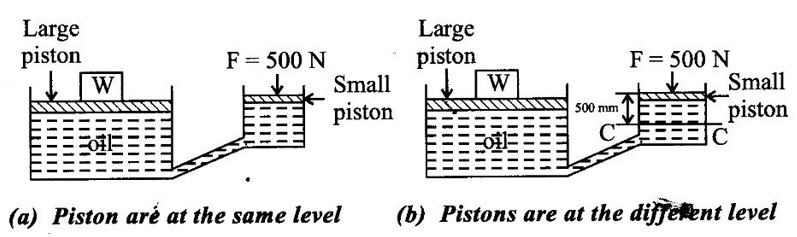
The diameter of a small piston a larger piston of a hydraulic Jack are 40 mm 200 mm respectively. A force of 500 N is applied on the small piston. Find the load lifter by the larger piston when

(i) The pistons are at the same level

(ii) Small piston is 500 mm above the large piston

Specific gravity of oil in the Jack is 0.92.

Given data:

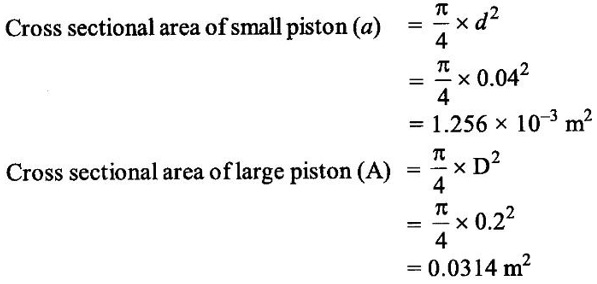
Diameter of small piston (d) = 40 mm = 0.04 m

Diameter of large piston (D) = 200 mm = 0.2 m

Force (F) = 500 N

Specific gravity of oil s1 = 0.92

To find:

(i) Load (W) when the pistons are at the same level

(ii) Load (W) when small piston is 500 mm above the large piston

Solution:


Density of oil (ρ) = 920 kg/m2


Case (i) when the pistons are at the same level

W W = 5.334 KN

Case (ii) when the small piston is 500 mm above the large piston

P = intensity of downward pressure at C-C level

= intensity of pressure due to 500 N + intensity of pressure due to 500 mm oil head.


Result:

(i) Load when the pistons are at the same level,

W = 5.334 KN

(ii) Load when the pistons is 500 mm above the large piston

W = 5.394 KN